
In October 2020, West Nile fever was identified for the first time in someone who had acquired the virus in the Netherlands. Since then, RIVM and other organisations have carried out ongoing research into West Nile virus in the Netherlands.
Aim of the study
The aim of this study is to determine, as early as possible, whether the West Nile virus is circulating in the Netherlands, and to use these insights to take timely measures and alert people to appropriate precautions.
'One health' collaboration
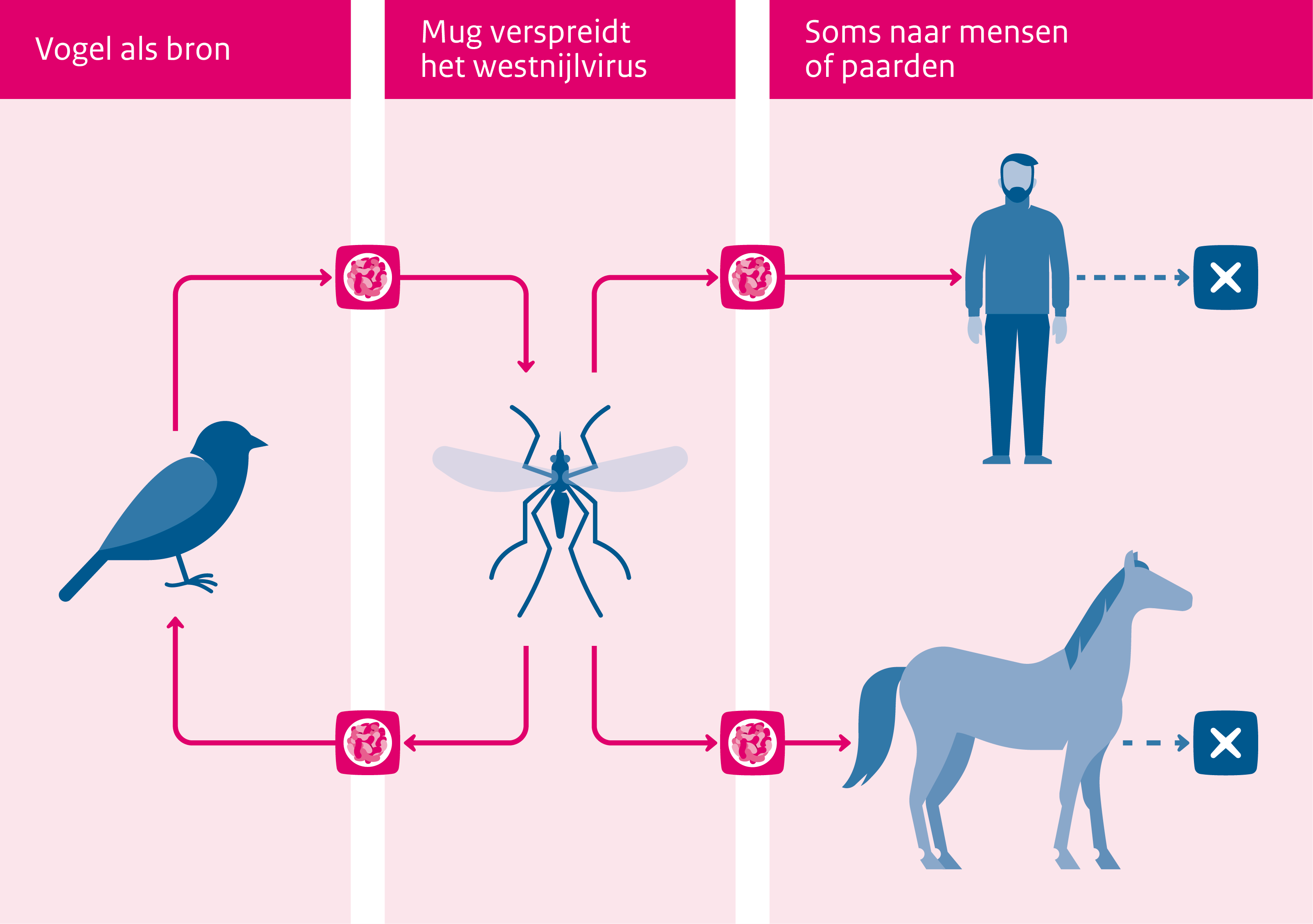
The West Nile virus occurs in birds and is spread by common house mosquitoes feeding on blood from infected birds. The mosquitoes can spread the virus to other birds, horses (and sometimes other mammals) and humans. That is why experts with different areas of expertise in the fields of public health, animal health, ecology and living environment, are working closely together to study, prevent and control the (disease caused by) West Nile virus. Different experts look for different types of indications.
This close collaboration to promote human health, animal health and the environment is called 'one health'. Without collaboration, vital indications could be missed.
Collaborating parties
The following parties are involved in the study of West Nile virus in the Netherlands:
- RIVM - Centre for Infectious Disease Control (CIb)
- NVWA Incident and Crisis Centre (NVIC)
- NVWA Centre for Monitoring Vectors (CMV)
- Erasmus MC - department of Viroscience
- Sanquin Research
- Royal GD
- UU – Dutch Wildlife Health Centre (DWHC)
- WUR - Wageningen Bioveterinary Research (WBVR)
- The Netherlands Institute of Ecology (NIOO-KNAW)
Detecting early indications
The parties involved are jointly monitoring whether the West Nile virus is circulating in the Netherlands. RIVM will coordinate these efforts. Indications of West Nile virus come from diagnostic testing in humans and horses with symptoms, and from surveillance in birds and mosquitoes. Proactive monitoring allows us to see where West Nile virus is present and how this changes over time. This is important for taking timely action and actively alerting people to precautionary measures. Below we share more details about the research by area of expertise.
- West Nile virus in birds
- West Nile virus in mosquitoes
- West Nile virus in horses
- West Nile virus in wild animals
- West Nile virus in humans
West Nile virus in birds
West Nile virus circulates among birds and is transmitted between birds by mosquitoes. Songbirds in particular are susceptible to West Nile virus infection. If West Nile virus is detected in sedentary birds (i.e. birds permanently resident in the Netherlands), this means that the virus is circulating in the Netherlands.
Since 2016, NIOO-KNAW bird ringers, together with DWHC and Erasmus MC, have been conducting research into mosquito-borne viruses in live and dead birds. More than two hundred ringers have been trained to collect and study samples throughout the Netherlands. In recent years, this has proved to be a valuable early warning system. These studies, with additional diagnostics by Erasmus MC, provide valuable data to monitor and better understand the spread of West Nile virus in the Netherlands.
West Nile virus in mosquitoes
Common house mosquitoes can get the West Nile virus by feeding on blood from infected birds. These mosquitoes can then spread the virus to other birds and occasionally to horses (and other mammals) and humans. If West Nile virus is detected in mosquitoes, it means the virus is circulating.
Understanding the mosquito populations in the Netherlands is important for estimating the risks of infection for humans and animals. The Erasmus MC Viroscience department conducts research into viruses that mosquitoes in the Netherlands can transmit to humans and animals. The NVWA provides mosquito traps and additional mosquito testing in locations where the West Nile virus has been detected. In addition, the NVWA is committed to preventing mosquito nuisance.
West Nile virus in horses
Horses may occasionally become infected with West Nile virus by a bite from an infected mosquito. A small proportion of horses then develop neurological symptoms. Horses cannot spread the virus via mosquitoes. A horse cannot infect other horses or people.
If the West Nile virus is detected in horses, it indicates that mosquitoes infected with the virus are active and can spread the virus. Diagnostics of West Nile virus in horses with neurological symptoms are important for the treatment of horses. If a horse tests positive, the veterinarian can advise the owner on appropriate measures. A West Nile virus horse vaccine is available as a preventive measure.
In the Netherlands, WBVR, NVWA and Royal GD are involved in monitoring horses. Royal GD is monitoring horses for symptoms that could indicate West Nile virus. WBVR carries out tests for this purpose. Veterinarians are required to report findings or suspicions of the West Nile virus to the NVWA . The NVWA conducts research based on reports. The national reference laboratory for notifiable animal diseases provides the final test results.
West Nile virus in wild animals
Infected mosquitoes could also transmit the West Nile virus to other mammals. DWHC monitors and investigates diseases in wild animals in the Netherlands and also monitors for the West Nile virus.
If anyone finds a dead wild animal, for example a wild bird or a fox, polecat, stone marten or weasel, they can report it on the DWHC website. The DWHC then adds the report to their general overview, and sometimes retrieves an animal for examination. DWHC reviews all reports daily and uses triage to determine which animals it retrieves for examination. In collaboration with Erasmus MC, the DWHC investigates the animal's cause of death and any diseases it had. The targeted selection of animals for testing will enable the DWHC to best identify the presence and spread of diseases among wild animals in the Netherlands, such as the West Nile virus.
West Nile virus in humans
People can become infected with the West Nile virus via a bite from an infected mosquito. Mosquitoes cannot transmit the virus from human to human and humans cannot transmit the virus to other people or animals, except through blood and organ donation. If a West Nile virus infection is detected in humans, it indicates the virus's presence in the Netherlands or, if detected in a returning traveller, abroad.
Human infections are monitored in a variety of ways, including:
- mandatory notification
- screening of donated blood
- syndromic surveillance
See below for more information.
Mandatory notification
The Public Health Act makes the reporting of West Nile virus infections in humans mandatory in the Netherlands. This means that West Nile virus infections must be reported to the Municipal Health Services (GGD) within 24 hours. The GGD detects the source of the infection (foreign/domestic and most likely location). RIVM collects these (pseudonymised) reports centrally for a national overview. West Nile virus infections are diagnosed in a medical microbiological laboratory. RIVM and Erasmus MC are the national reference laboratory for West Nile and other mosquito-borne viruses. RIVM is also the European Union’s reference laboratory for these viruses.
The core tasks of these reference laboratories are:
- reference diagnostics
- support of other laboratories with materials and technical advice
- monitoring the characteristics of the circulating viruses
- scientific development
- policy advice
Blood donations
The West Nile virus can be transmitted from human to human through the donation of body fluids, such as blood. Testing donated blood for the presence of West Nile virus gives insight into the circulation of the virus in the Netherlands.
In 2020, the first year of West Nile virus infections in humans in the Netherlands, Sanquin Research introduced an additional screening test for blood donors. This screening was discontinued at the end of 2021 as no further infections had been identified during that period.
In August 2026, Sanquin Research started scientific research into the presence of West Nile virus in blood donations. To this end, Sanquin tests donations of blood, platelets and quarantine plasma (plasma intended for direct transfusion) for the presence of West Nile virus. West Nile virus found in this study is further genetically analysed by the national reference laboratory at RIVM. Among other things, the genetic relatedness to other West Nile viruses can be used to determine whether the infection was acquired in the Netherlands or elsewhere in Europe.
In addition to the scientific research carried out by Sanquin Research, Sanquin has the statutory task of screening donor blood as soon as it is established that people have contracted infections in the Netherlands. This screening prevents blood containing viruses from being used for transfusion.
Syndromic surveillance
In less than 1% of infected people, infection with the West Nile virus causes neurological symptoms, such as problems with the nervous system or brain. By examining bodily material from people with such symptoms, who have not been diagnosed through standard testing, physicians can check for West Nile virus infection. This will help them to better understand diagnoses that were previously missed in severely ill patients. In addition, RIVM, together with other organisations in the Netherlands, is conducting research into the presence of antibodies for the West Nile virus and other mosquito-borne viruses.