
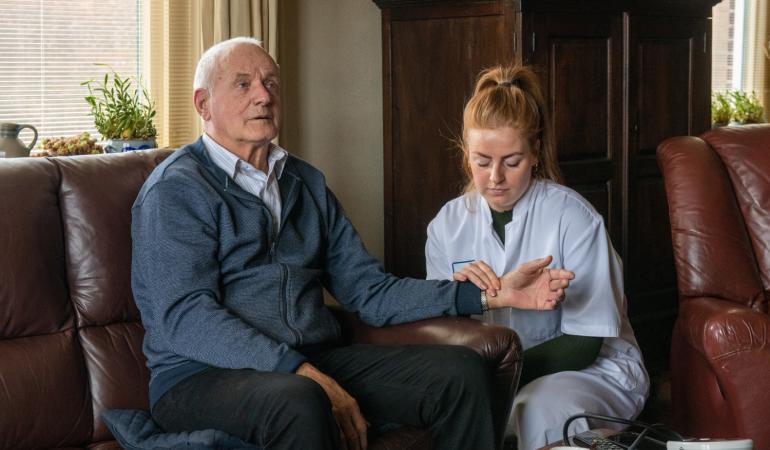
The demand for elderly care is not decreasing, but is instead increasingly shifting from care institutions to home-based care. This is the outcome of a study conducted by RIVM. Older people only move to a care institution when their care needs become more intensive, and their stays there are shorter than before. For one out of five of the care institutions studied, this resulted in a sharp decline in the number of clients between 2018 and 2024. Care executives and professionals view this shift in care as a structural development.
The number of older people in the Netherlands (aged 65 and over) is increasing. As a result, the number of older people requiring care is rising. The expectation is that the demand for care will continue to rise. Most older people receiving long-term care still reside in a care institution (112,000 in 2018 and 127,000 in 2024, representing 3.5% of the Dutch 65+ population in both years). However, there has been a greater increase in long-term elderly care at home, rising from 34,000 in 2018 to 78,000 older people in 2024. On average, the intensity of the care delivered during that period also increased. In the same period, the number of older people receiving district nursing under the Dutch Health Insurance Act fell from 257,000 to 240,000.
Occupancy of nursing homes
Nationally, the occupancy of nursing homes remained roughly stable. However, there were notable differences between them. Almost half of them saw an increase in occupancy, mainly for higher-intensity care needs. However, one in five nursing homes experienced a sharp decline in occupancy. For the other nursing homes included in the study, occupancy remained stable. It is possible that more nursing homes in the Netherlands experienced a sharp drop in occupancy than is reflected in these analyses. A number of nursing homes were not included in the study because the available data was incomplete. Some of them may have closed their doors, merged after occupancy rates fell too sharply, or lost their care contracts. The study also shows that the percentage of nursing homes without waiting lists (or with relatively short ones) increased slightly from 2023 onwards, rising from 10% to 13%. The percentage of nursing homes with no waiting list at all increased from about 8% in 2019–2024 to 9.5% in 2025.
Shorter stays in care institutions
The shift toward more long-term care at home aligns with the government’s aim to encourage older people to live at home for longer. Older people themselves also express this preference in the study. When they do move to a care institution, their stays are now shorter than in the past. The group staying for up to three months doubled during the study period. The percentage of older people staying for up to five months increased by 65%. At the same time, the number of older people who stayed for five years or longer decreased by 5%.
Conversations with professionals and older people
Care executives and professionals recognise this pattern. According to them, the shift toward long-term care at home often leads to shorter waiting lists or under-occupancy (temporary or otherwise) if the available capacity is still geared toward providing lighter care. They also find that the work is becoming more demanding. Older people have more complex care needs and they now spend shorter periods in nursing homes in the final phase of life. This means that staff have to prepare rooms for new clients more frequently. Older people value their independence and social environment and therefore want to continue living at home for as long as possible. They only start considering a move following an acute trigger, such as a stroke or a fall.
Consequences of the shift toward more care at home
As more care is provided at home, older people are increasingly moving into nursing homes only when there is no practical alternative. As a result, the care needs within institutions are on average becoming more complex. This requires care institutions and the professionals working in them to make adjustments. In addition, more modifications may be needed in older people’s homes, e.g. the installation of a stairlift. This means that care users and their informal carers must navigate multiple care access points, which increases their mental burden. Other RIVM research (in Dutch) also shows that the availability of informal carers is expected to be insufficient in the future.
Responding locally to changes
The interviews further show that care organisation executives respond differently to the shift toward more home-based care. Based on the study, it is recommended that care organisations be given local flexibility to respond to these changes, for example by developing new home‑care concepts. Executives interviewed for this study sometimes experience legislation, regulations and municipal policy as obstructive. At the same time, they point to good examples demonstrating that strong regional cooperation makes it easier to find joint solutions. This requires openness, a willingness to look beyond the interests of one’s own organisation and consideration of what older people find important when thinking about relocation, such as maintaining their social network in the neighbourhood.
About this study
This study was prompted by signals received in recent years by the Ministry of Health, Welfare and Sport and the Care Needs Assessment Centre concerning “unused capacity” (empty beds) in Nursing, Care and Home Care Facilities (VVT). This was notable because the Dutch population is ageing. The Ministry of Health, Welfare and Sport therefore asked RIVM to map developments in elderly care. This study primarily used data up to and including 2024. RIVM recommends repeating the study in two years in order to include developments after 2024.