
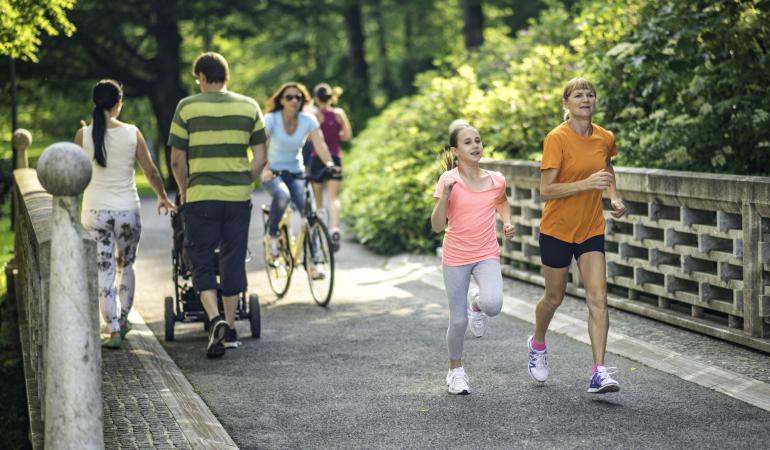
The current policy on sport and physical activity in the Netherlands expires at the end of this year. The National Institute for Public Health and the Environment (RIVM) investigated how societal developments could affect sport and physical activity up to 2040. The government can respond to these developments through new policy. RIVM has also expanded an existing computational model. The expanded model can be used to calculate the effects of measures designed to increase physical activity on factors such as diseases and healthcare costs. This allows the government to compare the effects of different measures and make better-informed choices.
Exploring the impact of societal developments
At the request of the Dutch Ministry of Health, Welfare and Sport (VWS), RIVM conducted an exploratory study into the future of sport and physical activity. The aim was to gain insight into how societal developments could affect sport and physical activity in the Netherlands up to the year 2040. Four themes were highlighted: sport and physical activity behaviour, sports experience, sport and physical activity providers, and the sport and physical activity environment. One of the developments investigated was population ageing. An ageing population will result in lower levels of physical activity and sports participation, fewer sports club members and lower satisfaction with the available sport and physical activity services. This information helps the government develop policy for the future. All the results are available on the sportenbewegenincijfers.nl website.
Effects of measures
The government wants to take measures to encourage people to be more physically active. RIVM used the model to calculate, among other things, what the effects would be if every adult were slightly more active each day. For example, if every adult walked for an extra 9 minutes a day or cycled for an extra 5 minutes, this could prevent almost 43,000 people from becoming ill by 2050. Healthcare costs could also be almost €1.8 billion lower, while labour productivity could be more than €460 million higher. RIVM can now use the model to make these kinds of calculations for various measures designed to encourage physical activity. This enables the government to compare the effects of different measures and make better-informed policy choices. RIVM also carried out this study at the request of the Dutch Ministry of Health, Welfare and Sport.
The computational model
The computational model was already able to estimate the impact of policy on the number of people who will smoke, drink alcohol or be overweight in the future. A component has now been added to indicate the extent to which increased physical activity helps prevent seven diseases, as well as the costs this will save in the future. These seven diseases are diabetes, stroke, heart attack, heart failure, breast cancer, colorectal cancer and dementia. The costs considered include both medical care costs and the loss of productivity when people are temporarily unable to work because of illness.