
Have you visited a place where ticks are likely to be found? Check yourself and others for ticks.
Tips to find ticks on the body
- Ticks are very small, only 1 to 3 millimetres. They are easy to miss. If you have just been bitten by a tick, at first it will look like a small black dot on your skin. Once they bite, ticks start drinking blood. After several days, they swell up to a brown or grey ball the size of a pea.
- Use a magnifying glass or mirror as needed to check in places that are difficult to see, or ask someone else to check you for ticks.
- Remember to check your clothing. Remove ticks from your clothes. If they are attached, wash your clothes at 60 degrees for at least 30 minutes, or put your clothes in the dryer.
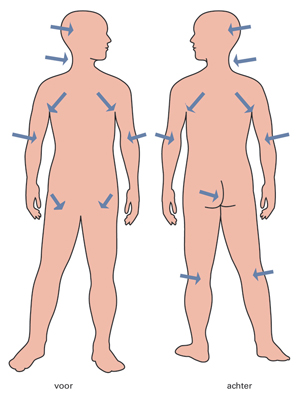
A recent study via Tekenradar.nl showed that ticks often bite children in different locations than adults:
| Children | Adults |
|---|---|
| Head and neck (32%) | Legs (55%) |
| Torso (chest, abdomen, back, shoulders and armpits) (27%) | Torso (chest, abdomen, back, shoulders and armpits) (22%) |
| Legs (25%) | Arms (11%) |
| Arms (10%) | Groin (9%) |
| Groin (7%) | Head and neck (3%) |
Read more about the study on where ticks bite.
This study shows the spots on the human body where tick bites are most common. It is still important to check the whole body for ticks, since ticks can bite you anywhere. So do not forget to check your groin, the backs of your knees, armpits, buttocks, along your underwear, behind your ears, and around the hairline at your neck.
Video
Video Checking for ticks
Light music plays
We see an animated video illustrating the voice-over narration.
Voiceover:
Have you been in an area where ticks might live?
Then it’s important to check yourself—and your children—for ticks.
Ticks can bite anywhere on the body.
Don’t forget to carefully check the groin, buttocks, armpits, along the edges of underwear, behind the ears, and around the hairline at the back of the neck.
Some of these spots are hard to check by yourself.
Use a mirror, or ask someone else to help you check.
A tick attaches itself to your skin.
It looks like a tiny black dot, about 1 to 3 millimeters wide.
As it feeds on your blood, it swells up over several days into a brown or grey ball about the size of a pea.
Found a tick?
Remove it as soon as possible—
using fine-tipped tweezers or a special tick remover.
Don’t forget to check the rest of the body afterwards.
Ticks often don’t come alone.
Want to know more?
Visit rivm.nl/en/ticks
Music ends
Logo of the National Institute for Public Health and the Environment, Ministry of Health, Welfare and Sport appears on screen.