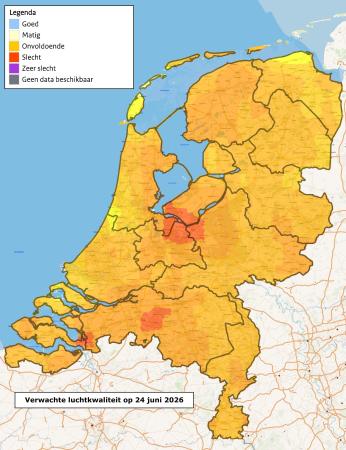
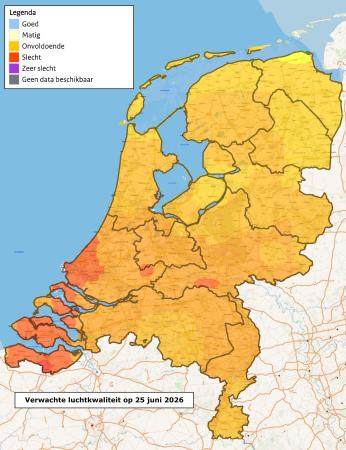
On Wednesday 24 and Thursday 25 June, air quality in the central and southern parts of the Netherlands is expected to be “poor” due to smog from ozone. On Wednesday, the chance of smog from ozone is highest in parts of Flevoland, Utrecht and in the central and western parts of North Brabant. On Thursday, smog from ozone is expected south of the line Leiden–Amersfoort–Apeldoorn. This could cause discomfort for people who are sensitive to smog. RIVM advises them to stay indoors and limit strenuous physical activity. This advice is most relevant in the late afternoon and early evening, when the air will be most polluted.
Smog from ozone may cause a worsening of respiratory symptoms, such as coughing and shortness of breath, as well as a worsening of asthma symptoms and reduced lung function. It may also irritate the eyes, nose and throat. Relatively speaking, people with respiratory symptoms, children and the elderly are most sensitive to smog. Contact your GP if you experience symptoms.
Ozone forecast for the days ahead
The situation for Friday 26 June is still uncertain. Warm and sunny weather will continue and the wind will come from the south and east. These are conditions under which high ozone levels can be expected. If ozone concentrations rise so high that there is a significant risk of smog, a separate update will be issued.
Smog due to ozone
Smog due to ozone is the result of an accumulation of pollutants in the air on sunny days. This occurs in spring and summer when there is little wind (that is mainly blowing from the south-east). The pollutants include nitrogen oxides and volatile organic compounds, which the sunlight turns into ozone. This is also known as ‘summer smog’. In other seasons, the UV radiation is not high enough to create significant amounts of ozone concentrations.
(European Union) information and alert thresholds for ozone
The EU has established information and alert thresholds for ozone. The EU information threshold is 180 micrograms per cubic metre of air. When this threshold is crossed (or about to be crossed), people who are sensitive to smog may start experiencing symptoms. RIVM will send out a warning when this happens. As per the Dutch air quality index, the air quality will be ‘poor’.
The EU alert threshold is 240 micrograms per cubic metre of air (air quality ‘very poor’ according to the Dutch air quality index). When this threshold is crossed, everyone may start experiencing symptoms. RIVM will change the warning to an alert before this happens.
More information
- Visit luchtmeetnet.nl(link is external) or NOS Teletekst page 711 for current and expected smog levels.
- Visit rivm.nl for the maximum concentrations per hour or eight-hour period, as measured by the monitoring stations in the National Air Quality Monitoring Network over the last few days.
- You can also visit rivm.nl or the national GGD website for the living environment for more information about smog.
- Read more about lung diseases and air pollution on the website of Lung Foundation Netherlands (Longfonds).