
This page provides information about the estimated disease burden of COVID-19 and influenza, expressed in DALYs.
Expressing disease burden in a single measure makes it possible to compare the loss of health caused by different diseases. Such comparison is important for prioritizing policies and resources for combating (infectious) diseases. A commonly used measure for disease burden is the disability-adjusted life year, or DALY. Disease burden in DALYs reflects the sum of healthy life years lost due to illness and disability (years lived with disability: YLD) and due to premature death (years of life lost: YLL). Detailed descriptions of the methods used can be found in a previous edition of the State of Infectious Diseases (in Dutch).
This page presents estimates of DALYs for COVID-19 and influenza. The disease burden of long-term effects after a SARS-CoV-2 infection, known as the 'post-COVID syndrome', is not included. A more extensive description of these two infectious diseases, as well as 35 other infectious diseases in the Netherlands, is published in the State of Infectious Diseases 2024 (in Dutch).
COVID-19 highest disease burden, followed by influenza
In 2024, COVID-19 caused the highest disease burden among the various infectious diseases in the Netherlands, just as it did in 2023, with an estimated burden of 18,000 DALYs (95% CI 16,800–19,300). In 2024, the disease burden for COVID-19 was slightly higher than for influenza (16,500 DALYs, 95% CI 15,500–17,000). In 2023, the disease burden of COVID-19 was still more than three times higher than that of influenza with 38,000 compared to 10,900 DALYs respectively. The higher disease burden of influenza in the 2024/2025 season compared to previous years is related to a higher estimated influenza incidence. However, caution is needed when directly comparing the disease burden between these two diseases, as the estimates are based on different sources.
Since 2022, the disease burden of acute COVID-19 has been decreasing sharply. This is mainly due to a reduction in the number of severe cases, even though there were still many mild infections. The proportion of disease burden caused by premature death has also decreased since 2022. In 2021, more than 95% of the disease burden was caused by premature death; by 2024, this had dropped to 72% (13,000 DALYs). The total YLD, which is mainly caused by mild infections, was 4,980 DALYs in 2024, compared to 6,150 in 2023.
| DALY (95% confidence interval) | |||||
|---|---|---|---|---|---|
| 2020 | 2021 | 2022 | 2023 | 2024 | |
| COVID-19 | 207.000 (203.600-210.400) | 219.900 (215.300-222.600) | 93.800 (91.600-96.100) | 37.800 (36.400-39.200) | 18.000 (16.800 – 19.300) |
| 2020/2021 | 2021/2022 | 2022/2023 | 2023/2024 | 2024/2025 | |
| Influenza | NAa | 14.200 (12.600-16.000) | 9500 (8600-10.400) | 10.900 (10.100-11.800) | 16.500 (15.500 - 17.000) |
Figure 1. Estimated healthy life years lost due to illness and disability (years lived with disability: YLD) and life years lost due to premature death (years of life lost: YLL) for influenza (respiratory season 2019/2020 to 2024/2025) and COVID-19 (calendar years 2020–2024).
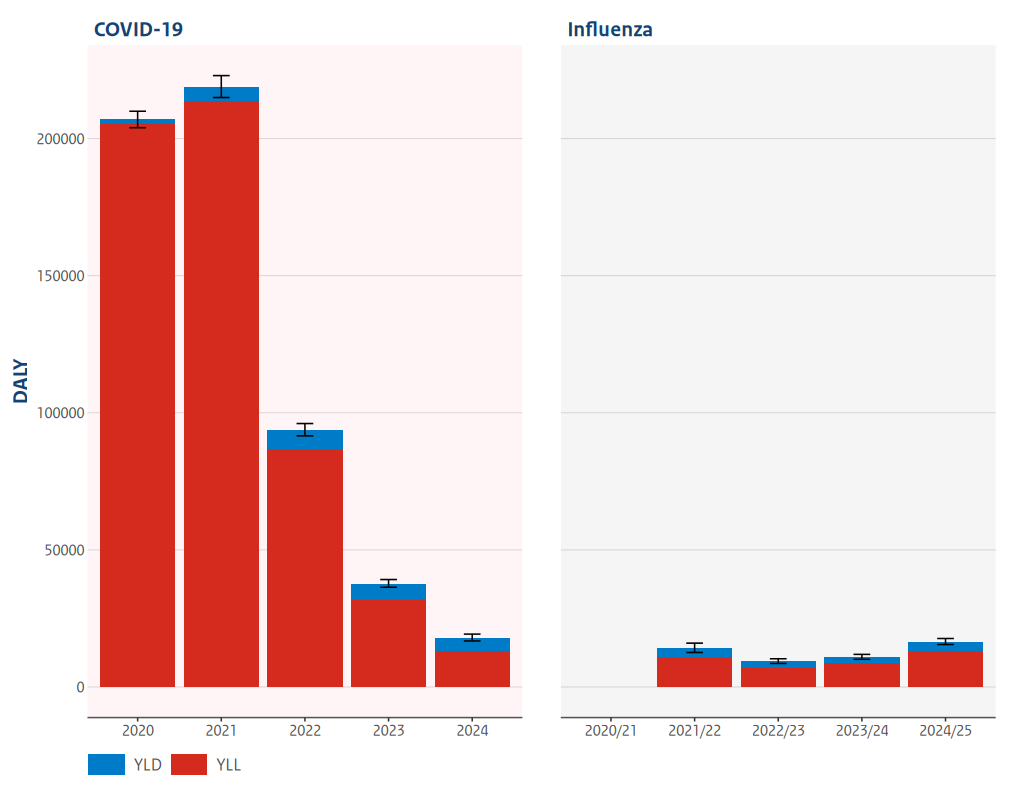
Note: In the winter season 2020–2021, it was not possible to estimate the disease burden of influenza using the current methodology.
More about surveillance of respiratory infections