
RIVM on Advanced Materials, June 2026
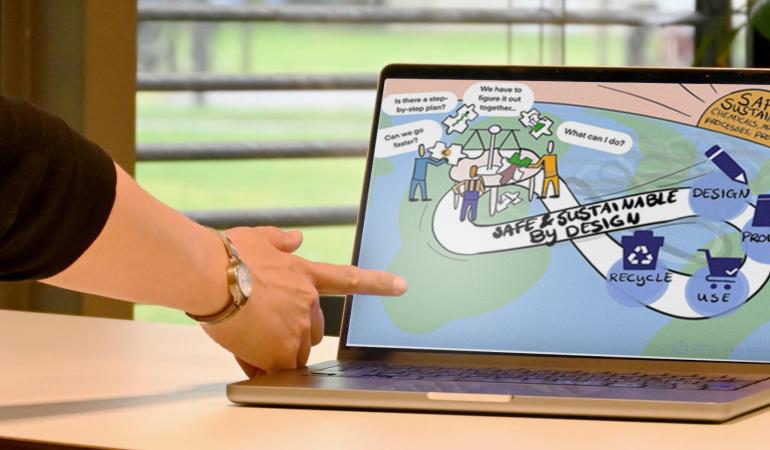
Safe-and-Sustainable-by-Design
The Advanced materials are becoming an increasing focus within European research, innovation, and competitiveness policies. At the same time, expectations are growing for these materials to meet Safe and Sustainable by Design (SSbD) principles, as reflected in recent European Commission policy initiatives and framework updates. RIVM emphasises the urgent need for stronger coordination between material innovation and policy development. This entails better knowledge sharing, clearer guidance for innovators, and structured dialogues, such as regulatory sandboxes, to support both material innovation and regulatory preparedness.
Navigating the advanced materials innovation landscape
Recent European policy developments show that Advanced Materials are expected to play a pivotal role in strategic sectors and EU Research & Innovation priority areas. In parallel, various tools and approaches are being developed to assess the safety and sustainability of AdMas. This raises an important question: what do innovators need to navigate this evolving policy landscape and balance safety, sustainability and economic value?
A changing European Policy Context
Recent initiatives by the European Commission (EC) illustrates the changing policy landscape for advanced materials. The EC’s Competitiveness Compass, published in January 2025, identifies AdMas as one of the advanced technologies crucial for strengthening the European economy in the future. It also announces the intention to establish an Advanced Materials Act, to stimulate innovation in this area.
At the same time, the EC has updated its Safe and Sustainable by Design (SSbD) framework. This framework was originally developed as part of the Chemical Strategy for Sustainability, and the EU Green Deal, which focuses on reducing pollution, climate, biodiversity, circularity, and human health. The updated SSbD framework emphasises its role in supporting both the Competitiveness Compass and the Chemical Industry Action Plan.
Together, these developments indicate that Europe has high expectations of Advanced Materials to stimulate economic growth, while also emphasising that this growth must align with safety and sustainability principles.
State-of-the-Art SSbD tools for AdMas
Assessing the safety and sustainability of AdMas from the early stages of innovation is crucial, alongside considerations of competitiveness. Recently, several publications have discussed various tools, testing approaches (such as grouping strategies), and decision support systems for AdMas. Publications by Wohlleben et al. and Pomar-Portillo et al. analyse and organise existing methods and tools for hazard, exposure, fate and risk assessment. In addition, the OECD has recently reviewed tools, integrative systems and platforms that support design, risk assessment and sustainability considerations for nanomaterials and nano-enabled products.
These publications and their contents aim to support industry in the iterative process of SSbD, allowing developers to revisit design choices as new information emerges, and ensure that safety, sustainability, and performance considerations are integrated throughout the innovation process. The OECD review also highlighted the need for improved data quality, Findable, Accessible, Interoperable, and Reusable (FAIR) data for SSbD, and the establishment of governance models for these platforms to ensure their quality.
Reflection by RIVM
Recent policy and material developments show strong commitment to innovation in safe and sustainable advanced materials, and a need for better coordination between these realms. Bridging this gap requires robust tools and high-quality data that support innovation in early- and mid-stage design decisions, while also helping regulators and policymakers strengthen regulatory preparedness in time.
Specifically, we propose a coordinated approach to address the following questions:
- To what extent can different AdMas be assessed with current methods, and which methods and data gaps should be prioritised?
- How can innovators be guided in selecting the appropriate approach (tools, testing approaches and integrative systems) for their specific assessment needs?
- How can knowledge generated during assessments be shared within the innovator-regulator ecosystem to facilitate the agile development of regulations and policies?
- How can we ensure that all the data, tools and approaches developed in projects remain available after those projects end, rather than being lost or repeatedly redeveloped?
RIVM’s sees two priorities for improving coordination between technical developments and policy ambitions for advanced materials: stakeholder dialogue and sustainable knowledge infrastructure.
First, regulatory sandboxes, an environment where innovators can test new products under flexible regulatory conditions while ensuring consumer protection and regulatory oversight, and other forms of open dialogue between innovators and regulators show their role in regulatory preparedness. RIVM encourages more experimentation within the SSbD AdMa ecosystem, allowing any stakeholder to initiate an open dialogue (e.g. on questions listed above).
Second, RIVM sees a need for stronger integration of existing AdMa platforms. A more coordinated platform landscape, supported by sustained funding and sound governance, could help prevent fragmentation and support the harmonised development of the SSbD advanced materials ecosystem.
Contents RIVM on Advanced Materials June 2026
- EU Commission prepares Advanced Materials Act to drive innovation and strengthen competitiveness
- Prediction of In Vivo Behaviour of Nanoparticles Using PBPK Models: Key Findings and Recommendations
- EU highlights strategic importance of advanced materials for medical devices
- Advanced materials and SSbD: why stronger coordination is now needed
- Information on Functionality can be used for Early Safety Assessment of Advanced Materials