
RIVM on Advanced Materials, June 2026
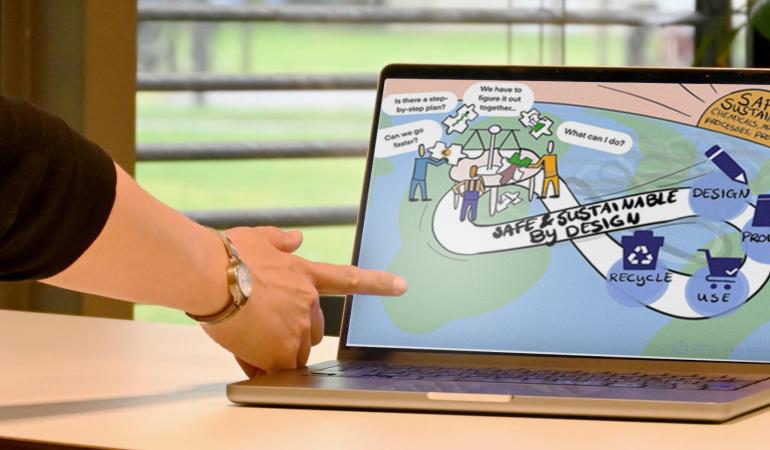
Safe-and-Sustainable-by-Design
The SUNSHINE project introduces a functionality-safety approach to enhance the safety of advanced materials by linking their designed properties to potential safety risks during early development. This approach seeks to facilitate safer innovation by identifying potential safety issues associated with material functionalities, ultimately guiding targeted testing and redesign. The approach adds value to existing Safe-and-Sustainable-by-Design approaches as it starts from the perspective of functionality and could be applied from a very early innovation stage. It can therefore be beneficial to incorporate functionality-safety relationships in the European Commission’s Material Commons infrastructure.
SUNSHINE’s Functionality-Safety approach
Researchers from the European Union’s Horizon 2020-funded SUNSHINE project propose a novel approach to facilitate the improvement of safety of advanced materials by linking their designed functionality directly to potential safety concerns early in material development. The approach aims to support safer innovation and helps ensure that advanced materials deliver societal benefits without harming humans and the environment.
The promise and potential risks of advanced materials
Advanced materials, such as multicomponent nanomaterials (MCNMs), are increasingly engineered to deliver enhanced performance in applications including construction, energy, medicine, and environmental remediation. These enhanced functionalities arise from deliberately modifying material properties, such as elasticity, reactivity, conductivity, or dispersibility. However, the same properties that enable novel functions can also influence how materials are released into the environment, how they interact with living organisms, and if or to which extent they are toxic. Here we hypothesize that mechanical properties mostly affect the extent or form of release from a MCNM-enabled product, due to, e.g., abrasion, weathering, use, or end-of-life.
Limitations of early safety assessments
Traditional safety assessments and existing Safe-and-Sustainable-by-Design (SSbD) approaches predominantly rely on toxicological data, which are typically unavailable during early research and development. By contrast, information on functionality-related material properties is usually known from the outset but remains largely unused in safety decision-making. The proposed approach addresses this gap by systematically linking functionality-related properties to three key aspects of risk: release, fate and toxicokinetics, and toxicity.
Linking material properties to safety risks
Using literature evidence and expert judgment, the researchers qualitatively assessed 21 material properties commonly engineered into MCNMs. Their analysis shows, for example, that changes in a material’s mechanical properties can strongly affect its uptake and distribution in organisms, while modifications to its reactivity may affect toxicity. Meanwhile, other properties, such as optical or thermal characteristics, generally pose lower risks, although the authors note that less information is available correlating these properties with the three risk aspects.
Guiding safer innovation
Importantly, the SUNSHINE framework does not address sustainability aspects and does not aim to predict whether specific material properties increase or decrease risk. Instead, it serves as a basis to identify potential safety issues associated with intended functionalities, thereby guiding targeted testing, material redesign, or grouping and read-across strategies. The authors emphasize that their approach should be paired with tools that address sustainability and other aspects of SSbD and can be applied to advanced materials beyond MCNMs.
Reflection by RIVM
The SUNSHINE framework offers an innovative approach to early safety assessment of multi-component materials by focusing on functionality rather than on physicochemical properties alone. This approach complements the Early4AdMa approach and other SSbD methodologies aimed at identifying potential health and environmental effects. The link between functionality and relevant safety aspects should also be exploited in the digital infrastructure of the European Commission’s Material Commons. Together, these approaches serve as powerful tools for identifying early indicators of potential safety issues, facilitating more proactive, efficient, and sustainable innovation.
Contents RIVM on Advanced Materials June 2026
- EU Commission prepares Advanced Materials Act to drive innovation and strengthen competitiveness
- Prediction of In Vivo Behaviour of Nanoparticles Using PBPK Models: Key Findings and Recommendations
- EU highlights strategic importance of advanced materials for medical devices
- Advanced materials and SSbD: why stronger coordination is now needed
- Information on Functionality can be used for Early Safety Assessment of Advanced Materials