
In this chapter
After setting up your foresight study in Phase 0, the next steps comprise scenario development—an approach to systematically exploring possible futures and supporting robust decision-making. Scenario development is a structured process, combining both qualitative and quantitative methods, that enables organizations and policymakers to anticipate change, understand uncertainties, and prepare for a range of potential outcomes.
First, a conceptual framework is developed to visually map key variables and their relationships, often through literature review, stakeholder engagement, and techniques such as mind mapping or causal loop diagrams.
Next, horizon scanning systematically identifies future trends and driving forces using frameworks like DESTEP, ensuring a comprehensive understanding of factors that could shape the future. Once identified, these driving forces are ranked by importance and uncertainty.
Scenarios must also define their geographical scale (local to global) and time horizon (short- to long-term), so they are tailored to decision-maker needs and relevant contexts. Scenario logics are then selected to structure internally consistent and contrasting scenarios.
Finally, scenarios are developed by combining qualitative narratives with quantitative data where possible. This process draws on various methods, from expert panels to simulation modelling. The result is a set of scenarios that are systematic, internally consistent and plausible descriptions of possible futures.
| Steps: Actions and Objectives | Method |
|---|---|
| Group model building, flowchart software, sessions |
| |
| |
| |
| |
|
3.1.1 What is it?
According to Elangovan & Rajendran (2015), a conceptual model is a “framework that is initially used in research to outline the possible courses of action or to present an idea or thought” [8]. It is often used interchangeably with a conceptual framework. A conceptual framework is a representation of a system and it consists of the variables to be considered in the foresight study and the relationships between them. It can be seen as a further elaboration of the research question. Common elements of a conceptual framework are independent variables and dependent variables. The latter ones can be further specified into moderating variables and impact variables. Conceptual models often have a visual nature and are generally developed based on a literature review of existing studies about your topic.
3.1.2 Why is it important?
A conceptual model provides a simplified representation of complex systems or phenomena, making them easier to understand for stakeholders with varying levels of expertise. It can also be important for communication as a common language, facilitating discussions, collaboration, and knowledge sharing among stakeholders. For foresight a conceptual model can be used to represent the underlying mechanisms driving system dynamics. The conceptual model is a tool to analyse the interaction of the chosen topic/issue with other aspects that may influence it. Therefore, the process of building a conceptual model allows you to understand the scientific framework of the topic and subsequently facilitate the definition of the objective and the identification of driving forces. With the conceptual model, the identified areas also allow you to predict the type/logic of scenarios that will be used (i.e. certain fields are more suited to qualitative and/or qualitative scenarios).
3.1.3 Methods
Conceptual models are built by exploring the environment and context in which the study is conducted. This can be achieved through stakeholder collaboration or through literature reviews, or even, studies dedicated to context exploration. It is important to understand that an existing conceptual model normally is developed with a certain purpose, which does not always align with the purpose of foresight. Since foresight has a strong dynamic nature, it helps to have that represented in the conceptual model that you might develop.
3.1.3.1 D(P)SIR
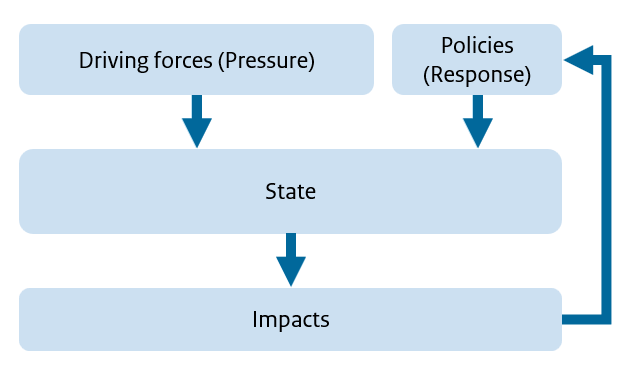
A system dynamics (SD) approach can support that since it is particularly suitable to depict the dynamics of a system. A SD-technique that is often applied is the Driving forces-Pressure-State-Impact-Response categorization in which pressure sometimes is left out or merged with the driving forces. There are many variations on DSIR but the main purpose within foresight is that the use of it obliges you to entangle the underlying mechanisms and enforces a more causal-effect way of describing the issue at hand.
3.1.4 Other methods
Mind mapping is a visual technique that involves creating a diagram to represent concepts and their relationships hierarchically. Starting with a central idea or concept, related concepts are connected through branches, creating a visual representation of the conceptual framework. Mind mapping helps organize thoughts and ideas, making complex relationships more understandable. Concept mapping is similar to mind mapping but focuses on representing the connections between concepts more explicitly, often using labelled arrows or lines to indicate relationships.
These two methods are relatively easy to apply. Another more comprehensive method to develop a conceptual model is Group model building (GMB). GMB involves bringing together diverse stakeholders, such as policymakers, experts, community members, and representatives from various organizations, to collectively build and refine a system dynamics model of a complex problem or issue. It can result in a formalised conceptual model in the form of a causal-loop diagram. A causal loop diagram (CLD) is a visual representation of the causal relationships and feedback loops within a complex system. It is a type of systems thinking tool used to illustrate how different variables or factors within a system interact with one another and influence system behaviour over time. It is good to be aware that applying a GMB requires a substantial amount of time and results in a conceptual model as representation of the knowledge present in the group of stakeholders.
3.1.5 Additional step: linking a conceptual model with indicators
A conceptual model has often a high level of abstraction. It includes aspects of relevance (e.g. health care) without clarifying what kind of operationalization you might give to it (e.g. health care expenditures, number of general practitioners). To make the conceptual model more concrete you might opt to link the different aspects of the model to real world indicators. It might also make clear that sometime for some aspects a direct operationalization is lacking (e.g. quality of life) and you have to look for proxies. By making this link, you can also specify for the indicators which data sources you could use to quantify these indicators.
3.2.1 What is it?
There are various definitions and description of what horizon scanning is. JRC defines it as a “Systematic exploration, acquisition and use of information about events, phenomena and trends, and their mutual relationships (JRC, 2021) while Hines specifically include early signs (Systematic examination of information sources to detect early signs of important developments (Hines, 2013)). Similarly, the definition of Future motion included besides strong signals (coming from research and well known sources) also weak signals (identify signals for change, emerging issues) (Future Motion, 2018). Others, have a stronger focus on impact such as “the systematic identification of new and emerging health technologies that have the potential to make an impact on health and/or health services” (EuroScan, 2009). There is also a strong connection, and sometimes confusion with Environmental scanning which can be seen as an emerging issues analysis (Molitor, 2017).
3.2.2 Why is it important?
Horizon scanning is important for foresight studies because it provides a way to systematically gather and analyse information about the future, which can help to inform decision-making and planning processes. It is good to note that normally horizon scanning is an essential element, but not the end point of a foresight study (ref).
3.2.3 Method
Making an inventory of driving forces involves systematically identifying and cataloguing the key factors that influence a particular situation. Methods to do the DESTEP analysis are: literature review: conduct a comprehensive review of existing literature, reports, and studies relevant to the situation, stakeholder consultations through interviews, surveys or workshops. A broad representation of stakeholders can provide valuable perspectives and help identify factors that may not be readily apparent. You can use structured exercises and techniques to systematically identify and analyse factors.
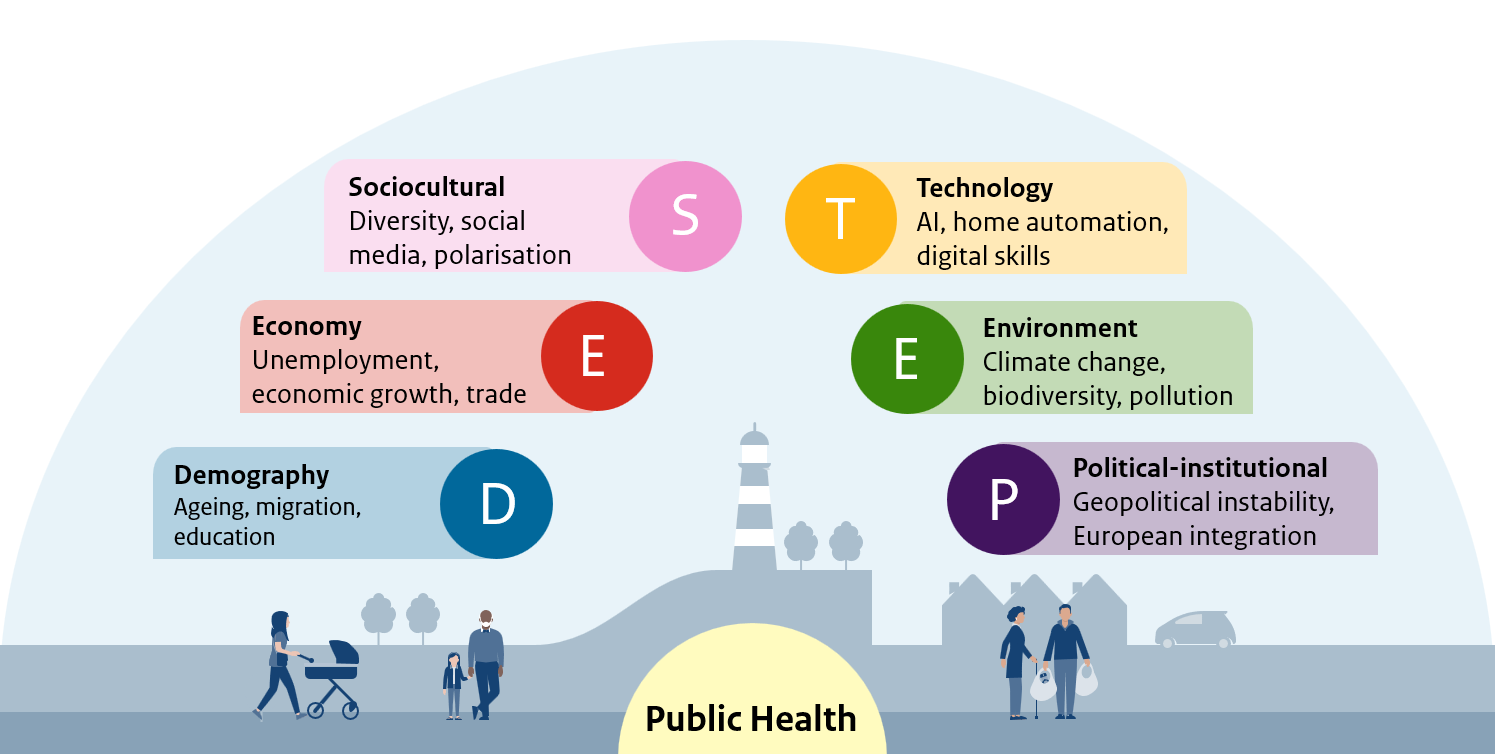
One of the these techniques is the DESTEP, an acronym that encompasses the dimensions of demographics, economic, social-cultural, technological, environmental, and political-institutional factors. Originally, in 1967, Aguilar introduced a similar acronym, ETPS, which excluded the environmental dimension. Over time, the framework underwent transformations, leading to variations like PEST, STEP, and more. Another variant, PESTEL, extends the framework by adding a legal dimension, acknowledging the critical role of legal factors which is more applicable in the context of business environments. The acronym STEBNPDILE might be one of the most extensive ones, introducing more dimensions such as business methods, natural resources and international factors. Sometimes, trends in values are also made explicitly (e.g. STEEPV). We recommend, however, to devote attention to values separately, by the distinction of normative uncertainties. This is mainly due to the importance of the normative aspects in many foresight studies, notably in public health. The choice for which “letters” to use, depends on the topic. For public health and other applications, DESTEP has been proven to be rather useful. Applying the DESTEP technique results in a list of trends, relevant in the context of the issue at hand.
3.3.1 What is it?
Ranking driving forces by uncertainty and impact involves a systematic analysis to identify and prioritize the most significant factors affecting a particular issue. It is good to realize that uncertainty here refers to the so-called cognitive uncertainty, uncertainty stemming from a lack of knowledge on future developments or limited knowledge how these trends influence outcomes. Technology trends are a good example for this cognitive uncertainty. The other form is normative uncertainty, which is connected to the different norms and values people have and thus people might not agree what they consider a desirable future.
3.3.2 Why is it important?
Ranking driving forces by uncertainty and impact is particularly essential for the next step, scenario development. Scenario development involves developing a set of plausible future scenarios based on different combinations of driving forces to explore possible futures and their implications.
3.3.3 Method
First, you need to assess importance and uncertainty. For the importance (also referred to as relevance), you want to assess the potential impact of each driving force on the issue. The conceptual model can help to describe how a driving force can influence the impacts. This can be formalised by including the pathways how this influence goes. Second, you want to assess uncertainty (also referred to as likelihood) associated with each driving force. This one is more complex since the uncertainty comprises several aspects that have to be considered at once. It can be factors such as the level of consensus among experts and the level of predictability of future developments. The assessment can make use of desktop research though stakeholder (expert) workshops might be a preferred option. In this way, pathways are better identified, while at the same time consensus (or agreed dissensus) is established.
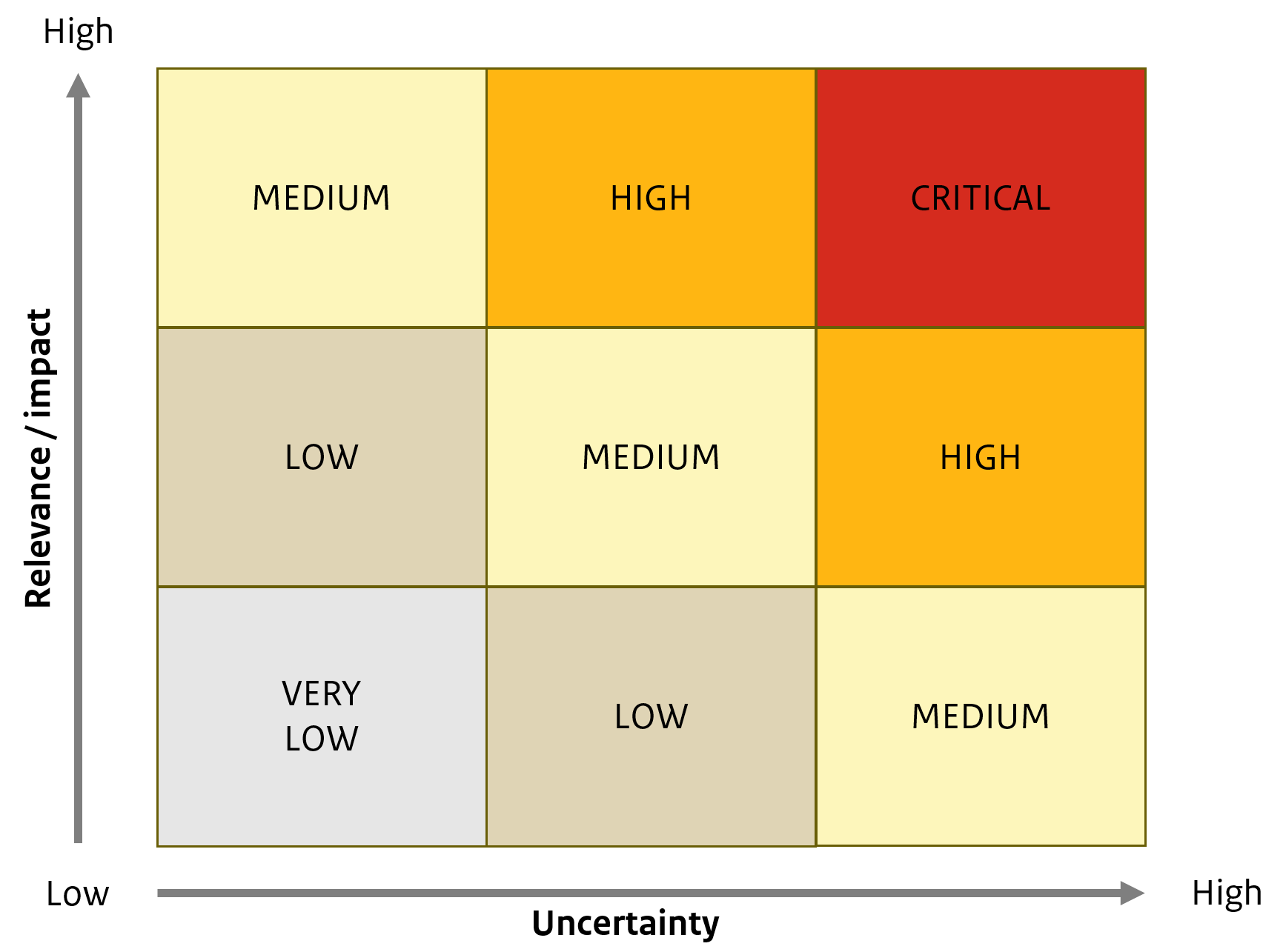
Once you have assessed uncertainty and importance for each driving force you can rank them accordingly. A preferred method for ranking is the Priority Matrix in which a matrix based on their uncertainty and impact levels. This visual representation (see figure) helps identify driving forces with high uncertainty and high impact, the critical ones, which will be the basis of your scenarios.
3.3.4 Additional method: clustering driving forces
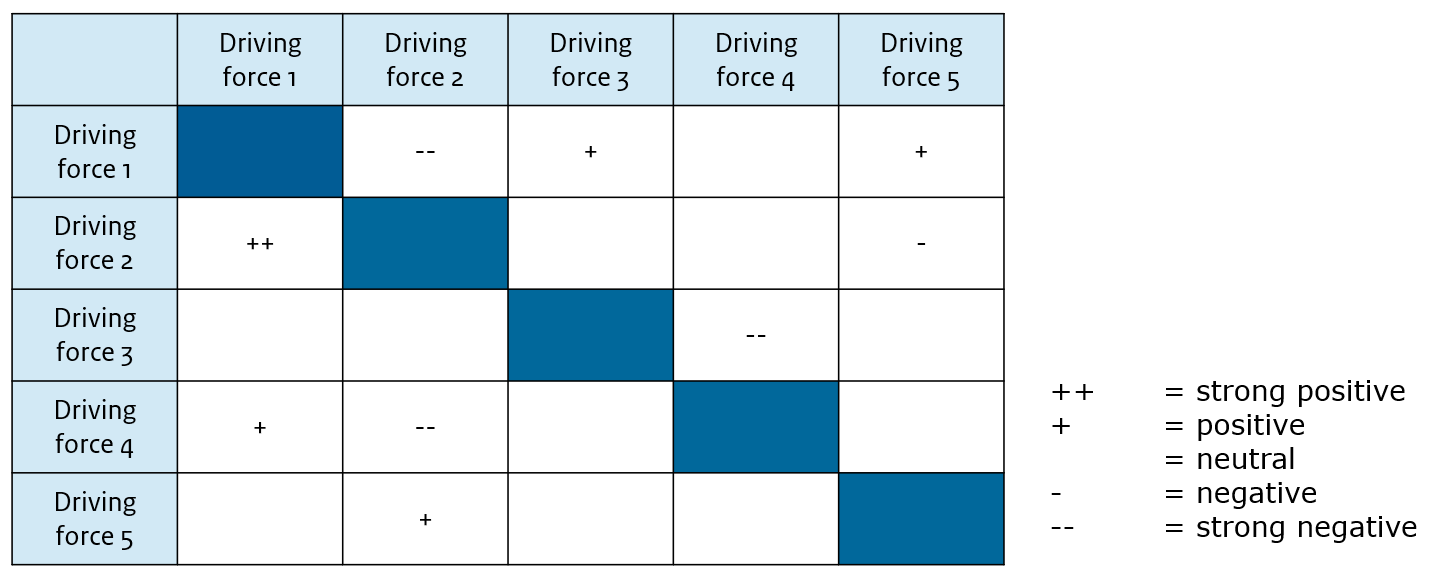
The priority matrix helps to order the DFs according relevance and uncertainty. However, it still regards all DFs separately, while there can also be interconnections between DFs. To cluster the DFs accounting for these interconnections, is essential for the next steps. The main question is how to cluster the driving forces and trends in a way that they will form a relevant and divergent set of scenarios. This requires a deep understanding of the driving forces, including the pathways how they might influence the impact indicators.
An important notion here is the dependency between driving forces. All these developments that we might be facing are often not occurring independent from each other. High economic growth might be combined with high immigration, and also with higher (global) temperature increase. High migration influences in its turn (ethnic) diversity, labour market and cultural habit, which might in turn influence life styles, and so on. There are several ways of capturing the dependencies (and clustering) between the driving forces. Cross-impact analysis is one of them that we highlight here. Other options are to support such an analysis with a more extensive (visual) representation of the cause-effect relationships (e.g. by using a mind map approach) or even apply a systems dynamics approach (e.g. group model building) to further specify and formalize the dependencies.
Cross-impact Analysis (CIA) attempts to work systematically through the relations between a set of variables, rather than examining each one as if it is relatively independent of the others. CIA requires a set of key variables, in this case driving forces, that are considered to be most relevant. Usually, expert judgement is used to examine the influence of each variable within a given system, in terms of the reciprocal influences of each variable on each other – thus a matrix is produced whose cells represent the effect of a variable on each other.
3.4.1 What is it?
Geographical scale refers to the area being studied, whether it is a local, regional, national, or global scale. Depending on the scale, different factors may come into play and affect the outcome of the study. For example, a study focused on a local scale may not take into account global trends and changes, while a study focused on a global scale may overlook important regional or local factors. Time horizon refers to the length of time being considered in the study. Depending on the time horizon, different trends and changes may be considered. For example, a shorter-term study may focus on immediate changes and trends, while a long-term study may consider more gradual changes and shifts over a longer period.
3.4.2 Why is it important?
By considering both the geographical scale and time horizon in foresight studies, researchers can develop a more comprehensive and accurate understanding of the future trends and changes in their chosen field.
3.4.3 Method and Outcome
The geographical scope is mostly defined by the commissioning client. The Ministry of Health might be mostly interested in the national level, while a municipality might want to focus on the local level. These choices should not be considered too rigid. For the national level, a subnational dimension could be relevant as well, for example, when looking at spatial differences. Also regarding the context of the national level, the European or even the global level might be relevant as well. Similar argumentation can be applied to the local level.
There is no clearcut method to choose the time horizon. You don’t want to set it too close into the future, since uncertainties are then not too relevant. Also choosing a time horizon too far into the future might result in more speculative scenarios, though this can serve a more visionary objective. Choosing a proper time horizon co-depends on the topic at hand, and the relevant driving forces for that topic. Obviously, with climate change as a focal point your time horizon might be further away (even more than 50 years ahead) than with a focus on technology (when a time horizon of 10 years might already challenging). With public health as a focal point, and the ageing of the population being a rather crucial aspect for this, 25 years might be an adequate horizon. That enforces people to think beyond small alternations of today’s era.
Note that thinking beyond one or two years requires considerable effort for many people, not only policymakers, and openness and creativity about future possibilities cannot be taken for granted. Policy makers might be comforted as well by emphasising that all far future findings will eventually be translated to policy actions for the coming years.
3.5.1 What is it?
Scenario logics is the necessary foundation to further develop relevant scenarios, that are plausible, systematic, consistent and contrasting. The scenario logics builds further on the key driving forces as selected in step x.x. In this step, the method to cluster the driving forces into a logical set of coherent trends, is chosen.
3.5.2 Why is it important?
This step is essential to move forwards after the horizon scanning. At the same time, this is very often the most difficult step that requires proper understanding of the results of the horizon scan, time, and, even more important, experience. The aim is to create a range of plausible and coherent scenarios that are internally consistent and that reflect the potential future(s). This is often one of the important objectives of a foresight study. It allows decision-makers to explore different possible futures and assess the risks and opportunities associated with each one. They can also help to identify potential blind spots and areas of uncertainty that need further investigation.
3.5.3 Method
Since this is one of the main and most complex steps in doing a foresight study, there are different ways of supporting this step. It is difficult to argue which method would be best for this. Here, we focus on the critical uncertainty approach (also referred to as the Shell approach). Given the importance of this step, also some other approaches will be elaborated on at the end of this section.
3.5.3.1 Critical uncertainty approach
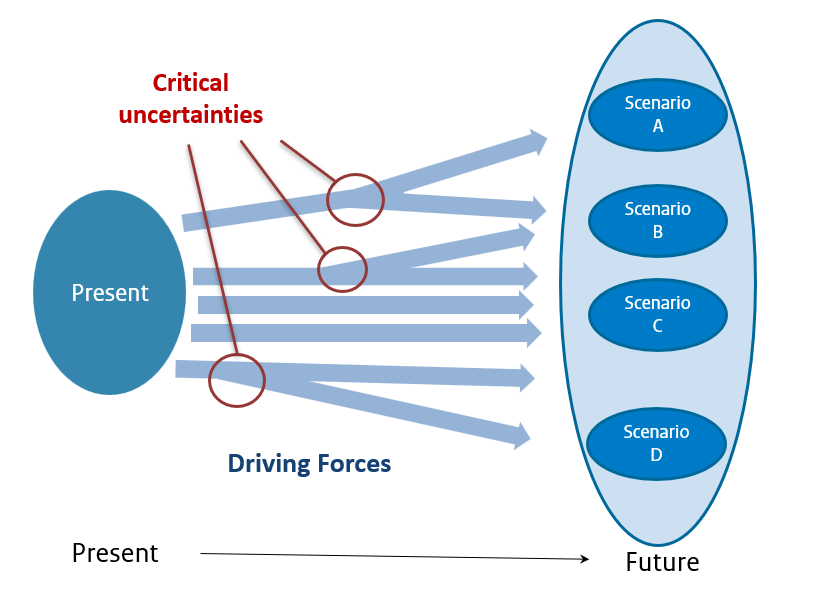
The critical uncertainty approach continues with the previous steps, the inventory of most important uncertainties, the critical uncertainties. Especially, the priority matrix is very helpful to select the most critical driving forces. These form the basis for the development of your scenarios. It is good to be aware that this is mainly the approach and does not provide practical step such as how to cluster the driving forces, how many critical uncertainties to select, how to combine uncertainties, etc.
3.5.3.2 Alternative methods
As mentioned before, there are alternative approaches. Some of them differ slightly, while others imply a whole different set of steps. It is also not always clear or agreed upon how these alternative approaches should be applied. The first alternative included here is the Four archetypes (Jim Dator). This approach uses four pre-defined templates of scenarios that provide your scenario logics: continued growth, collapse, discipline, and transformation.
- Continued growth is a future of continuation of current trends. It has similarities with a Trendscenario, or a business as usual (BAU) scenario.
- Collapse is a future where the system reaches its limit and collapses. Not clear is how to identify these limits or how to analyze them. This could be regarded as a worst case scenario.
- Discipline is a future of equilibrium. A steady state civilization focused on sustainability. This scenario could be regarded as a good case scenario, where you stay within the limit, without transformative changes.
- Transformation is a scenario that includes these transformative changes. It could be imply a change in how health is considered, or how society functions, though this is not too clear either. This might be regarded as the best case scenario but this not clearly stated.
Another alternative, which can also be seen as pre-defined scenario templates, is the three horizon approach This approach, Three horizons: a pathways practice for transformation (Sharpe et al 2016), also starts with a business-as-usual scenario (H1). The third horizon (H3) “represents the emerging pattern that will be the long-term successor to the current first horizon. It is appearing and growing on the fringes of the present system, and developing new ways of meeting the emerging conditions and possibilities.” This looks similar to discipline scenario of Dator, in which no structural changes are assumed. The second horizon (H2) is “the turbulent domain of transitional activities and innovations that people are trying out in response to the changing landscape between the first and third horizons. This second horizon is important, as it provides the disruptions for more radical 3H systems to emerge. Some innovations (H2+) will help extend the H1 systems and facilitate the emergence of H3 systems. Many innovations will fail, and others (H2-) will be absorbed back into the H1 systems and contribute only to marginal or incremental change. A good example are photovoltaic cells (solar panels).” This again, shows similarities with the transitional scenario of Dator, though maybe with more room for failure as well. The distinction between H2- and H2+ is not further specified.
Ecology and Society: Three horizons: a pathways practice for transformation
Both these approaches start from the present and look from there into the future. Many of the steps mentioned before might therefore be relevant as well for these approaches. It is easy to see how aspect such as the scenario question, governance structure, stakeholder participation, a conceptual model and the horizon scanning are relevant for these approaches as well. However, since we have not seen many applications within the field of public health it is difficult to assess how these steps might differ from the approach described in this guide.
A third method, included here, is the Trendscenario approach, or Business-as-Usual approach. This approach has been applied by RIVM in the some of its Public Health Foresight Studies (RIVM, 2018, 2020, 2024). This approach takes all the previous steps as well, but develops only one scenario, a Trendscenario, which has an overlap with the previous two approaches developing a BaU scenario. It assumes that current trends continue in the future, without the development and implementations of new or intensified policies. Such a Trendscenario approach is mainly meant to identify future challenges. In this approach, the uncertainty focus is more on these challenges (normative) instead of a focus on the cognitive uncertainties connected to the driving forces. The scenario question is then more focussed on what kind of future do we want. The Trendscenario can then be seen as an essential input to facilitate that discussion. Developing more explorative scenarios, i.e. the critical uncertainty approach, does not necessarily serve that purpose. These normative uncertainties can be focussed on the challenges arising from the Trendscenario, or also be used to further develop normative scenarios. These normative scenarios have then similarities with the other two alternative approaches. One major risk of relying only on one Trendscenario, more than in the multiple scenario approaches, is that the Trendscenario is interpreted as a prediction. Devoting attention to uncertainties, for example in the driving forces, is then key. In practice users are not always sufficiently made aware by this.
A scenario approach that does not start in the present but has a very strong focus on the future is a visionary approach, as a fourth alternative approach. There are not many known applications of this approach, at least not in public health. This approach might result in a broader range of scenarios that are less likely to occur but have a greater potential impact. It is used to encourage creative thinking and to challenge assumptions about the future. This approach relies more on a qualitative analysis of data and often results in a wider range of scenarios. It can be linked with the current day by applying backcasting. Backcasting is a strategic planning technique that involves starting with a desired future outcome and then working backwards to identify the steps that are needed to achieve that outcome. Also for the visionary approach, possibly in combination with backcasting, also requires different steps, with a strong focus on creativity.
3.6.1 What is it?
This is the final step to actually create a set of scenarios. The scenarios in this set are the results from the scenario logics, but do not have fixed formats. How many scenarios, a rather relevant facet, how quantitative will the scenarios be, are the scenarios more mainstream or more extreme? All these questions cannot be answered on beforehand and you need to find this out along the way. It is good to realize that more scenarios and more quantification in general require more resources.
3.6.2 Method
There is not one method that can be employed to develop the scenarios. It mostly comprises several methods to develop them. Here, a couple of useful methods are described, alongside some guidance aspects that provide direction. Let’s go back to the results of the Horizon scanning and the inventory of driving forces using the priority matrix.
3.6.2.1 How many scenarios?
Critical uncertainties are more dominated by normative uncertainties than by cognitive uncertainties.
Limited set of scenarios (1-4), with more effort on the identification of the different normative uncertainties (i.e. perspectives). In this case, a Trendscenario approach could be a choice. However, the above mentioned risks of having only one scenario might demand for at least two scenarios. This can be for example a high-low design. You still need all the steps in order to get a set of consistent, plausible and systematic scenarios.
One critical cognitive uncertainty
In the (rare) case that you find only one critical uncertainty, you use this DF as the backbone of your scenarios. You can opt for 2-3 scenarios around this DF. For example, two low-high scenarios, possibly complemented with a medium scenario could then be a suitable set for this. You still might want to do the clustering of driving forces for the assumptions of the less critical driving forces to safeguard consistency.
Two critical cognitive uncertainties
Using two critical uncertainties in a two-axes design has been very popular in the 1990s, with the IPCC as one of the most striking examples. The two axes are represented by the two uncertainties, classified as low-high, and thus form four quadrants. Each quadrant, as a combination of the two DFs represents a scenario. The clustering can also be applied to determine assumptions for other DFs. This rather straightforward, and attractive design has had many followers. However, experiences with this design are not always positive. First, the axes are preferable independent to have a similar plausibility of the four scenarios. This is however, not always the case. Secondly, the combination results in particular quadrants that are considered to be very unattractive, and therefore didn’t get proper attention. Thirdly, the identification of only two uncertainties was not always that simple. Often, reality was more complex than these two uncertainties represented.
More than 2 critical uncertainties
If you end up with more than 2 uncertainties, combining them similar with the two-axes design in more axes, results quickly in more combinations than you can handle. Three uncertainties has eight combinations, four uncertainties already 16. In this case, a morphological approach is appropriate. This approach is also referred to as general morphological analysis (GMA). Such an approach can be seen as a mixing panel with different DFs as the sliders, and their position (e.g. high-low) is argued based on the position of the other DFs.
All choices for the number of scenarios have pros and cons. The choice for one scenario might be result in the perception that it is more a prediction, with the choice for three scenarios, people instinctively might focus on the middle one, more than four scenarios requires a lot of explanation about the scenarios.
3.6.2.2 Qualitative and quantitative
Each scenario, no matter how many you have, has qualitative aspects. The qualitative aspects represent the storyline behind the scenario. What are main characteristics described in an attractive way. This is also referred to as narrative foresight, a method of capturing possible futures by creating stories or narratives that describe how different events, trends, and technologies might interact and shape the world. This approach to foresight involves using storytelling techniques to engage stakeholders and decision-makers in imagining and exploring different scenarios for the future. By creating compelling narratives that capture people's imaginations, narrative foresight can help to build a shared understanding of potential futures and the challenges and opportunities they may bring. Next to this qualitative dimension, a scenario can be deepened and made more concrete by the quantitative dimension. A story can be very compelling, but it is strengthened by adding numbers to the words. Such a quantification can be done by using existing projections, as long as the assumptions of these projections are consistent with the assumptions and storyline of the scenario at hand. Making your own projections, for example by using or developing a simulation model, can be very useful though also time and capacity consuming.
3.6.2.3 Detailed methods to develop scenarios
After the different considerations regarding number and the nature of scenarios, you have to further develop the scenarios. There is a long list of quantitative and qualitative methods that can be employed for this. This handbook will not specify preferred methods here; that depends too much on available resources, expertise and experience within your organization regarding different methods. We refer here to the overview provided by Popper.
Quantitative: Extrapolation of time series; Probabilistic forecasting; Stochastic processes analysis; Regression analysis; Econometric models; Simulation modelling; System dynamics; Impact analysis; Cost-benefit analysis; Input – output analysis; Game theory
Qualitative: Opinion surveys; Experts interviews; Focus groups / Expert panels; Delphi method; Design; Essays; Relevance trees; Morphological analysis; Catastrophe theory; Historical analogy; Visioning
3.6.3 Outcome
The outcome of this step is a description of the set of scenarios. This description is preferably qualitative (i.e. the storylines, possibly complemented with visual aspects) and a quantification where needed and possible. It helps to specify the main characteristics of the scenarios in an overview table (see an example below).
| Characteristic | Scenario 1 | Scenario 2 | Scenario 3 |
|---|---|---|---|
| What are the main driving forces (DESTEP) and the trends? | |||
| What are important events and outcomes | |||
| Who are the main actors playing a role in shaping the future? | |||
| What are main positive implications (opportunities) | |||
| What are main negative implications (threats, challenges). | |||
| Who are potential winners | |||
| What are vulnerable groups / losers? |