
In this chapter
- 2. Introduction
- 2.1 Defining the issues (and sub-issues) to be addressed
- 2.2 Project team and governance structure
- 2.3 Project Startup: a rehearsal of the whole foresight trajectory
- 2.4 Initiate the stakeholder participation process
- 2.5 Identify normative uncertainties & biases
- 2.6 Communication plan
Phase 0: Setting up the project and defining the why
Conducting a foresight study has many facets. Which methodology to apply is only one of the aspects. There are also various other aspects that you might take into account in order to end up with as foresight study that satisfies both the commissioning client and the foresight project team.
Therefore Phase 0 has been defined to support the initial scoping of the foresight study. This Phase 0 does not comprise the actual foresight work, but can be seen as an essential first step to be able to do and to oversee the activities included in the foresight study. It can be seen as a scoping phase which provides insights in all the step of the process of the actual foresight, Phase 1, 2 and 3. In Phase 0, several key steps can be distinguished:
First, a well-crafted research question is essential, as it focuses the study and clarifies objectives, often refined through discussions with project teams and/or commissioning clients. This ensures the study addresses relevant uncertainties and future trends, and is targeted towards the potential user(s).
Next, assembling a multidisciplinary project team and establishing a robust governance structure is crucial for credibility, effective management, and policy relevance. During project startup, outlining tasks, roles, timelines, and communication strategies helps align resources and expectations. Stakeholder participation is also vital, as it brings diverse expertise and legitimacy, achieved through mapping and targeted engagement.
Foresight studies may also identify normative uncertainties—subjective values and biases that shape what is considered a desirable future—and use methods such as value clustering or cultural theory to represent diverse perspectives. Recognizing and mitigating biases further strengthens the study’s validity.
Finally, a communication plan ensures that findings reach relevant audiences in tailored ways, supporting informed decision-making and transparency. Together, these steps lay a solid foundation for a successful and impactful foresight process.
| Description | Actions and Objectives | Method |
|---|---|---|
| What question(s) to address? | 1. Defining the issues (and sub-issues) to be addressed | Sessions with commissioning client (brainstorming / workshop), report |
| 2. Sessions with commissioning client (brainstorming / workshop), report | Report | |
| 3. Stakeholder participation process | Mapping and selection using GRIP, Power-Interest matrix, report | |
| 4. Address normative uncertainties & biases | Group-grid matrix of Thompson, Bias wheel, report | |
| 5. Make communication plan | Report, memo or PowerPoint presentation | |
| 6. Project rehearsal | Sessions, brainstorm |
2.1.1 What is it?
In foresight, a research question is a fundamental inquiry that guides the exploration of future scenarios, trends, and possibilities. It serves as the focal point for the foresight study, defining the specific area of investigation and outlining the objectives and goals to be achieved. A well-crafted research question prompts researchers to delve into key uncertainties, emerging trends, potential disruptions, and their implications for future decision-making.
2.1.2 Why is it important?
Defining a research question in foresight is essential for providing focus, clarity, and purpose to the study, engaging stakeholders, assessing feasibility, and evaluating outcomes. It serves as a guiding framework for conducting the study and ensures that it produces meaningful and actionable insights for shaping the future.
2.1.3 What are the methods to apply and what is the outcome?
Sessions with project team / commissioning client. You need at last 1 session to discuss the question at hand. However, it is advisable to have more sessions along the way, to tune expectations, needs and wishes.
Define the question(s) to be addressed. Limited knowledge of and experience with scenario thinking but also lack of full consideration what a question could be an what implications a question might have for addressing it with a foresight study make it in practice rather difficult to pinpoint the question. Revising the question, and further specifying it with sub questions is a practice that you have to undertake in sometime several session with the commissioning client. Even if there is no commission client you still have to do this, but then with for example the project team. The result of this step is an agreed scenario question, possible with sub-questions, that is to be addressed by the foresight study. You could start with the following guiding questions:
- What is the main topic to be addressed? Phrase this a question.
- What is the question behind the question?
- What is the nature of the foresight? Policy-oriented, signalling, finding support in society, etc
An example from the Dutch PHFS study is:
"What are the plausible future scenarios for the public health and health care in the Netherlands in the next 25 years, considering demographic changes, socio-economic trends, lifestyle trends, environmental factors, and technological advancements, what are the main societal challenges arising from these scenarios and what are options for actions to target these challenges?”
This question was further deepened by the three topical sub questions: How will technology influence health in the future, how does the future health care demand look like, and how will the wider determinants of health be of influence in the future.
2.2.1 What is it?
It might not need much explanation what this is. You need people to do a foresight study. First of all, you need a project team to coordinate and conduct the foresight study. Next to the project team, you might need an overall governance structure required to properly manage the daily activities of a foresight study. Such a governance structure refers to a framework that defines how decisions are made, and roles and responsibilities are allocated within the foresight project. A governance structure be have an internal dimension, i.e. within your organization, and/or and external one.
2.2.2 Why is it important?
A formal (external) governance structure can be very valuable for your foresight study as it can contribute to the validation of the method and results, support the conclusions, and increase policy relevance and its use. A robust governance structure is essential for ensuring the effectiveness, credibility, and relevance of a foresight study. If your foresight study has a specific mandate and well-formulated scenario questions, it will be easier to gain support for your governance structures and eventually also to get your results into the policy cycle.
2.2.3 Methods and outcome
The composition of the project team of a foresight study can vary in size. Some smaller studies might require only a few persons, while a bigger study, with more facets to be covered, might be better served with a bigger project team. In all cases you do need a project leader (or 2) that can oversee both the content and the methodology. A core project team of 3-4 people, also depending on the topic and available resources might be recommended. The project team should be soundly embedded in your internal organization structure, e.g. by installing an advisory or steering committee.
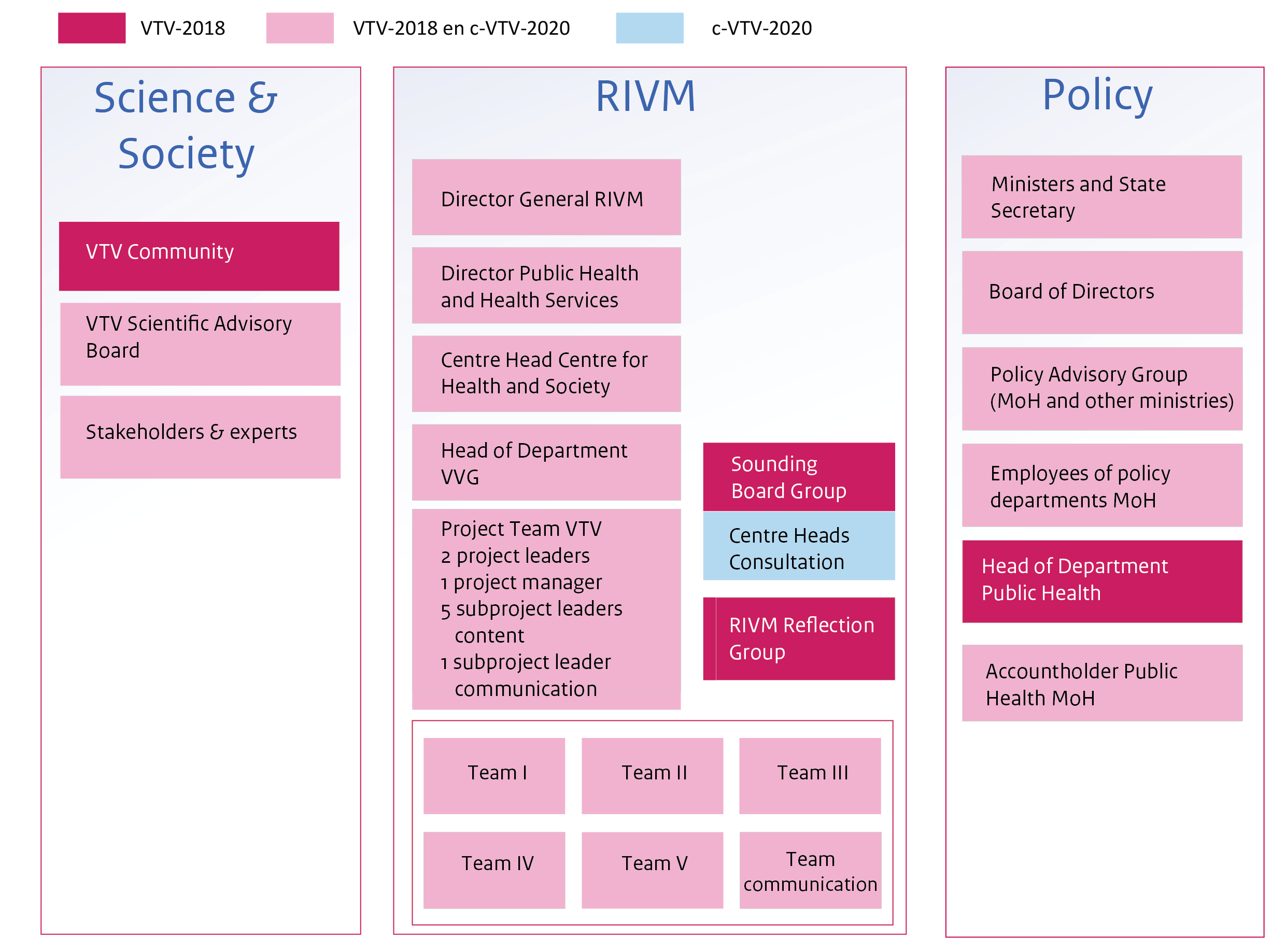
Regarding the external governance structure, you can opt for a formal scientific committee and a policy-oriented committee. To enhance societal relevance of your study there is a possibility to create a societal community which overarches the scientific and policy structures and includes a large diversity of societal organizations representing different groups (e.g. patients, elderly, migrants, health professionals, private sector). Internal structures may have the advantage of having relatively direct and to-the-point discussions, with people familiar to you. The specific needs of your study and the availability of resources will contribute to the choice of engaging with an external governance structure or opt for more ad-hoc consultations of different experts, policy makers or societal organizations, which require less resources. The further specification of the governance structure can be done in the course of Phase 0, depending on the outcomes of the other steps, and, of course, depending on available resources. An extensive governance structure requires sufficient capacity to let it function in an effective manner.
It is advisable to specify the roles, tasks, responsibilities and authority of the project team and the different governance bodies in a report.
2.2.4 Example of the RIVM’s PHFS governance structure
Project team consisting of 1 or 2 project leaders supported by a core team with different disciplinary backgrounds such as health sciences, demography, mathematics and communication. The governance structure has 3 pillars, relatively extensive due to the importance and relevance.
2.3.1 What is it?
In a project startup you try to foresee the activities that have to be undertaken in the foresight study. It gives the overview of tasks, expertise, capacity needed to bring your study to a satisfactory result. It can also shed first lights on methodology, participation and products.
2.3.2 Why is it important
By following these steps and investing time and effort into the startup phase of a project, you can set a solid foundation for successful project execution, foster stakeholder engagement, mitigate risks, and achieve desired outcomes. Especially, this step should ensure that you can devote sufficient time and capacity to activities that occur maybe at a later stages in the project and that activities at an earlier stage do not consume disproportionate capacity. An example for this is the horizon scanning (see also xx), that can be done in an over ambitious way while it serves mostly as a first, essential, step for scenario development. Another example is the communication facets of your study which should be considered at an early stage as well.
2.3.3 Method and outcome
A project startup (PSU) can useful as a method. Though this is not a specific foresight method, a PSU sets the stage for successful foresight project execution by establishing clear objectives, assembling the right team, engaging stakeholders, developing a comprehensive plan, and mitigating risks. By investing time and effort into the startup phase, project managers can increase the likelihood of achieving project goals and delivering value to stakeholders.
In a PSU it can be very useful to use the three general elements of a foresight study: Purpose & Methodology, Process & Participation, and Product & communication as a guidance to assess adequate time and capacity for all elements. It is not the objective to go in dept into all these elements, however, it is merely meant to sketch general outlines. For example, what will be the orientation of the foresight study (e.g. regarding uncertainty, policy, target audience), how does the landscape of stakeholders look like (e.g. clear overview exists, complex with contrasting views) and what are possible products (e.g. media channels to reach out to target audience such as a website, report, scientific papers etc).
A useful technique for this the GANTT chart. This is a bar chart that illustrates a project schedule. This helps to think about the whole trajectory of your project, mapping all activities. Using the three main categories: Purpose and methodology, Process & Participation and Products & Communication might be used, or the four phases as outlined int this document. There is for example an Excel template that makes it easy to start making a Gantt chart.
The project start up can be described in a (brief) report or presentation. This may be revised during the course of the project.
2.4.1 What is it?
A stakeholder is any individual, group, or organization who has an interest in your research project or affects or is affected by its outcomes. Stakeholders include those who are both supportive as well as less supportive or critical of your research. The stakeholder mapping provides an overview of whom you potentially would like to engage in your foresight study.
The engagement of stakeholders can have different aims (MNP, 2008). They can be:
- Quality aims (such as knowledge, values)
- Instrumental aims (such as support, being known about)
- Democratic aims (everyone can participate, representativeness)
- Emancipation aims (such as empowerment of participants)
It should be made specific why stakeholders are involved in the foresight study. Note that in different phases of a foresight study, different objectives might prevail to engage them. Also, you should realize that stakeholder participation process can be intensive and demands resources in terms of time and finances. In addition, one needs proper skills and experience to facilitate and moderate such a process, for example doing stakeholder workshop.
2.4.2 Why is it important?
Stakeholder participation plays a crucial role in foresight studies. Stakeholders bring diverse viewpoints, expertise, and knowledge to the table. By engaging both scientific and non-scientific stakeholders, foresight exercises benefit from a broader understanding of complex issues. Their insights can enrich the analysis, ensuring a more comprehensive exploration of potential futures. Their participation can also stimulate that the study remains contextually relevant and addresses real-world challenges. By involving stakeholders, foresight practitioners can tailor scenarios and recommendations to specific societal needs. Stakeholder participation enhances foresight quality, legitimacy, and relevance.
2.4.3 Methods
There are various method available for stakeholder mapping and selection. We include here three methods that can be used complementary to each other. You can also focus on one of these methods, depending on the current overview that you might have already regarding the stakeholder landscape, and the available time.
2.4.3.1 Mapping using the GRIP-method
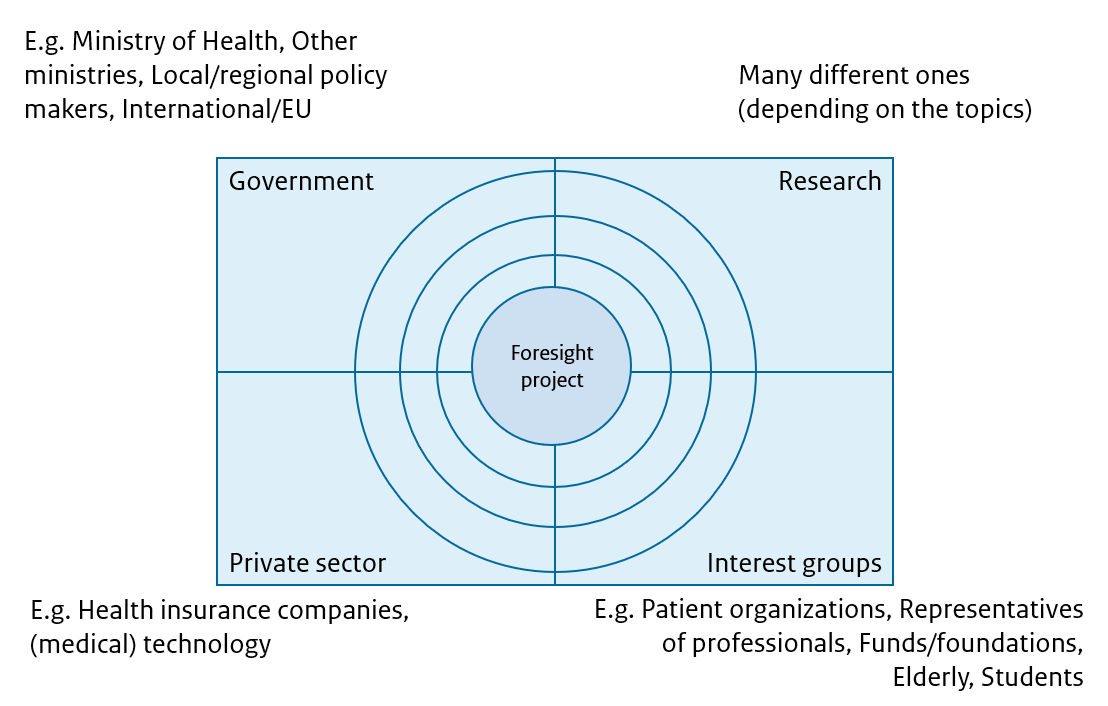
The GRIP method can be applied to get a general mapping of the stakeholder landscape. It uses the categorization Government, Research, Interest groups and Private sector to get a broad overview of the potential stakeholders that you might reach out to. Using the concentric circles already visualizes the stakeholders that are closer or further away from your foresight study. This can already give a first indication of which stakeholders are of most interest to engage. You can do this stakeholder mapping with the foresight project team, possibly complemented with relevant persons.
2.4.3.2 Selection of stakeholders
Once the general mapping is done, possibly resulting in a list of 30-40 stakeholders, you might want to select the most relevant stakeholders to engage with. This relevance depends of course on the objective you have regarding stakeholder participation. If the aim is more democratic or emancipation, you might focus on other stakeholders (e.g. interest groups maybe at more distance) than when you are looking for complementary knowledge on specific topics which might call for more research-oriented stakeholders.
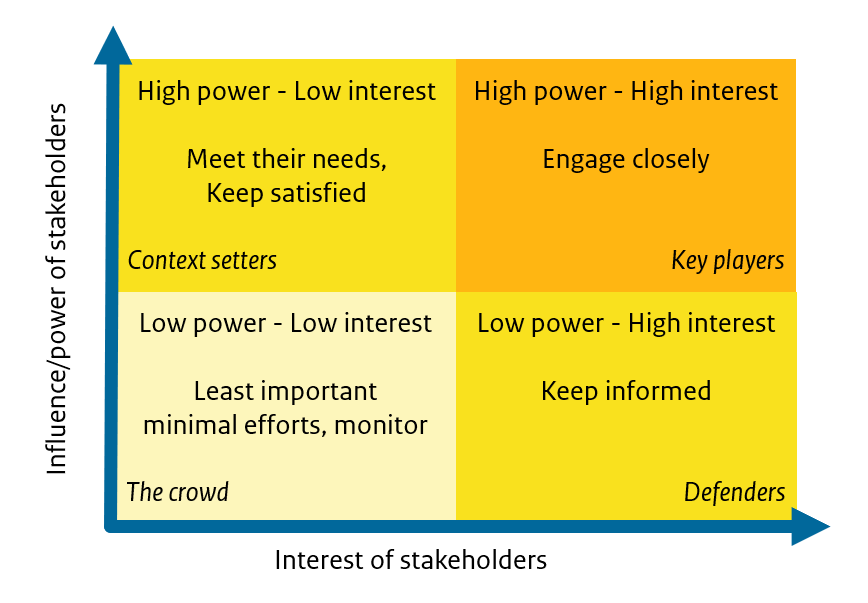
An objective that most foresight studies adopt is to get known about, to have the results being used and to get support for your findings, the instrumental objective. For this objective, the Mendelow’s Power-interest matrix can help to select stakeholders that have an interest in your foresight study and are important regarding the power they have. The Interest represents their level of interest in the project and the power the ability to influence an organisation strategy or act on the outcomes of a project. Mapping the list of stakeholders on the four quadrants then results in the most relevant stakeholders, the quadrant in the upper right with the key players. This does not mean that the other quadrants should be completely ignored. These stakeholders have their own value when they are involved in the foresight study.
2.4.3.3 Additional methods
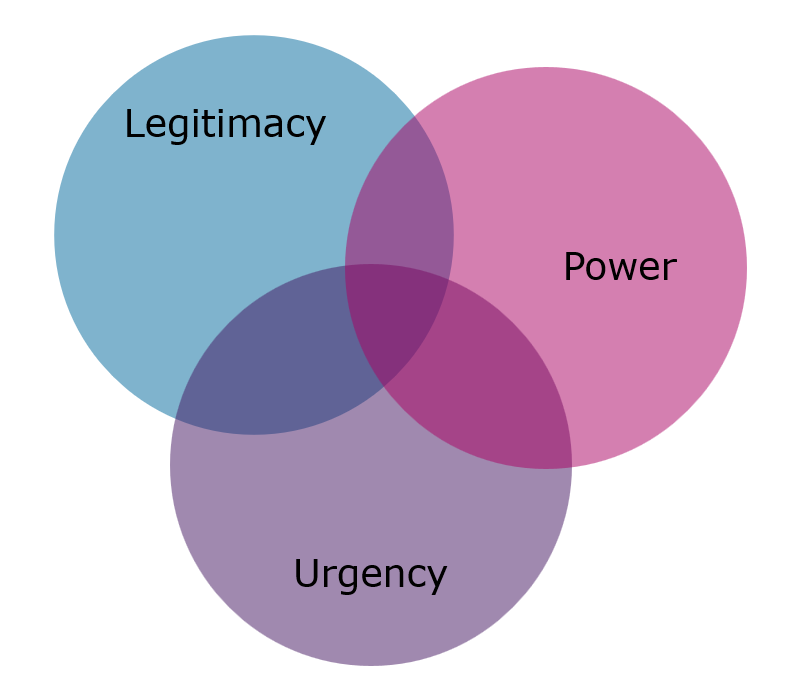
Instead of using two dimensions in the priority matrix, you could also distinguish three, urgency, legitimacy and power, forming a Venn diagram. Then stakeholders that combine all three aspects with a high score on each of them, are the most important ones (are 1 in the figure below).
In addition to these methods using dimensions or attributes you can also have a more descriptive method that describes characteristics, roles and interconnections of stakeholders. Also for this step, there various methods available to do so. Here, two additional methods are mentioned. One concerns a more detailed description of the stakeholders (see table below). Additional fields can of course be added.
| Stakeholder name (group or organisation) | Stakeholder A | Stakeholder B | Stakeholder C |
|---|---|---|---|
| Interest High/ Medium/ Low | |||
| Power/Influence High/Medium/Low | |||
| Aspects of the project likely to be of interest | |||
| Ways in which we might motivate engagement in project | |||
| Influence of stakeholder may affect the project | |||
| Influence of possible project outcomes on stakeholder | |||
| Suggested form of engagement | |||
| Key relationships with other stakeholders | |||
| Key contact(s) and best way of contacting them | |||
| Participation of stakeholder in previous networks and projects |
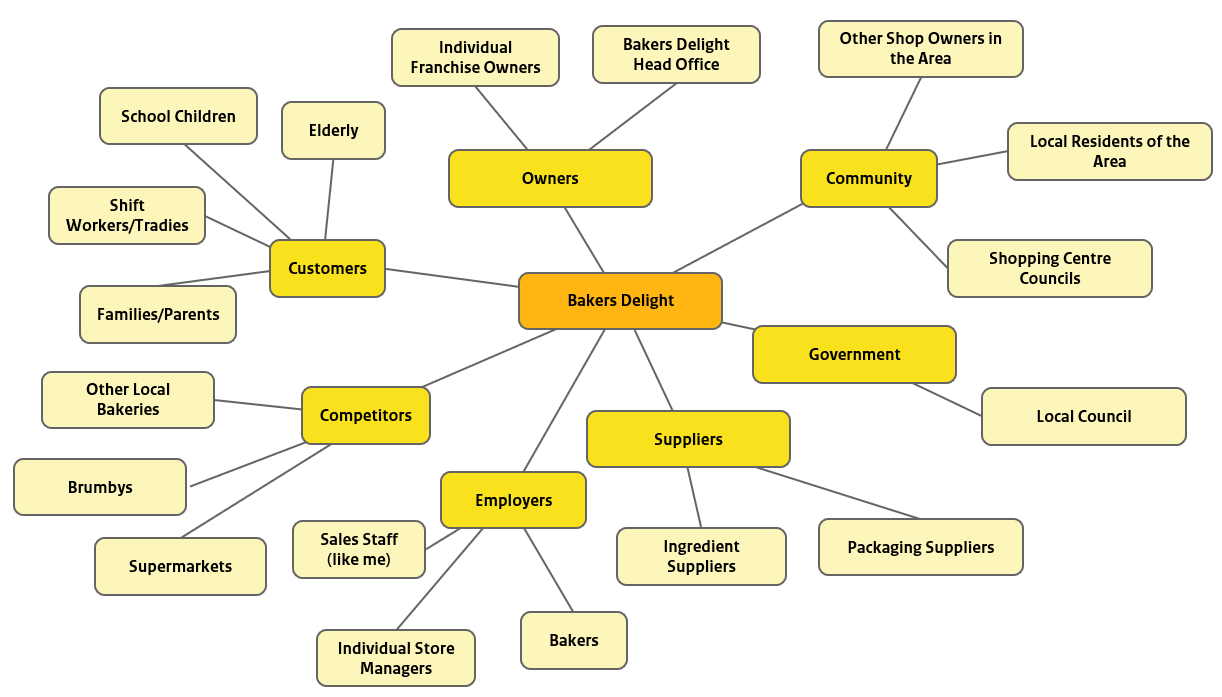
A second additional method that can be helpful is making a mind map of stakeholders, including the connections between them. This might result in a representation of stakeholders, comparable to the GRIP method, including also connections between the different groups.
2.5.1 What is it?
Normative uncertainties in foresight refer to uncertainties related to what is considered to be desirable in the future. These uncertainties are related to values, ethics, and moral considerations, and they are often subjective and context-specific. For example, in the context of public, normative uncertainties may arise around questions such as: what level of health inequalities is acceptable? What is the best way to allocate limited health care resources ? What are the ethical considerations of treatments? Foresight practitioners must be aware of these normative uncertainties when developing scenarios and making recommendations for the future. Related to this subjectivity, a foresight study, like any other study, is also subjected to biases. Biases in foresight refer to systematic errors or deviations from rationality that can affect the accuracy and reliability of foresight analysis. Biases can arise from various sources. Biases can affect the way in which normative considerations are incorporated into foresight analysis. For example, confirmation bias, which is the tendency to seek out and interpret information in a way that confirms pre-existing beliefs, can lead to an overemphasis on certain values or ethical considerations while ignoring or downplaying others. Similarly, groupthink, which is the tendency for group members to conform to a dominant view, can lead to a narrow range of normative perspectives being considered.
2.5.2 Why is it important?
Especially in foresight, both the normative aspects, what is a desirable future, and the biases, are we taking into account all possible futures trends, even if they are less desirable, is important. Also, with the involvement of stakeholders their stakes will also play a role in the process as such. To be more explicit about both the normative uncertainties and the possible biases of the project,
2.5.3 Method and outcome
This is one of the least applied aspects within scenario approaches. There are only few research groups who explicitly distinguished these normative uncertainties. The method is there still rather heuristic in nature.
2.5.3.1 Different perspectives
To identify different perspectives, related to normative uncertainties, it is important to start with the underlying values people attach to the topic at hand. As a project team you could play a part though it is strongly advisable to have a stakeholder participation process organized as well, to have different perspectives represented in the consultation.
- Longlist of values (by project team or stakeholder sessions). What do you find important when thinking about your topic (e.g. health)
- Clustering of this longlist into a manageable number of perspectives (e.g. 7-8 perspectives) with the of software (e.g. Concept-Systems Global Max software). Discuss these perspectives with project team and/or stakeholders to get support for this first clustering.
- Further clustering of these into 3-5 clusters. The challenge here is to look for maximum contrast between perspectives and maximum consistency within them. The existing studies that distinguish normative uncertainties can be used as inspiration (Public Health Foresight Study Outlook 2014, the Nature Outlook 2010-2040 and the Sustainable Netherlands Monitor of the Netherlands Environmental Assessment Agency). Also making a (loose) connection with political perspectives, that are especially known for their normative nature, can be used as a check. Discuss these with project team and/or stakeholders to get support for this first clustering.
- Enriching the perspectives by describing them further, making use of the following characteristics: main values, motivations, concerns, challenges, winners and losers and (core) indicators.
- Validating and testing representativeness of the perspectives. This can be done by general survey or again in stakeholder session.
This results in a set of different perspectives. It might be the case that the perspectives are not sufficiently contrasting or that you cannot find consensus about the set. Also, you might not want to focus on normative uncertainties in your foresight study. In these cases, you could only focus on the cognitive uncertainties and leave this step out. It is advisable, however, to devote some effort to normative uncertainties since it helps to open up your own perspective, and widens the scope of the foresight study in the following phases.
2.5.3.2 Alternative method: use pre-defined perspectives of cultural theory
When time and resources are limited, you could think of a light version of this method as well. The cultural theory provides a pre-defined structure of different perspectives: The cultural theory identifies four perspectives that shape the way people view the world. These perspectives are:
- Hierarchical: This perspective emphasizes the importance of social status, power, and authority in shaping people's beliefs and attitudes.
- Egalitarian: This perspective emphasizes the importance of equality, fairness, and justice in shaping people's beliefs and attitudes
- Individualistic: This perspective emphasizes the importance of personal autonomy, self-expression, and individual choice in shaping people's beliefs and attitudes.
- Fatalistic: This perspective emphasizes the importance of fate, destiny, and the idea that events are beyond human control in shaping people's beliefs and attitudes.
- The fatalistic perspective might be less usable for linking with policy making, though it can also be an interesting thinking exercise.
2.5.3.3 Alternative method: the perspective game
One way of supporting awareness of these different perspectives is to play the perspective game. This game makes, in informal setting, clear how people can differ regarding their values and norms, and the consequences of these differences for public health and environment. Instead of following the method, you could play this game with the project team, commissioning client or key stakeholders to create awareness about the different perspectives.
2.5.3.4 Identify and avoid biases
To ensure that when doing a foresight study you are aware of biases, it is important to engage in reflective and critical thinking, and be transparent about the value judgments and ethical considerations involved in the analysis. To identify and where possible avoid potential biases the bias wheel helps to systematically group different forms of biases. The bias wheel is a helpful tool that groups biases into six categories in the scientific advice context. The first category is 'research biases,' which affect the generation and availability of evidence. The remaining five categories influence advisers' and policymakers' assessments of evidence, leading to decisions being made on its basis. The tool distinguishes between 'culture and value biases,' 'attention biases,' 'interest biases,' 'availability biases,' and 'association biases.'
Similar to the normative uncertainties, you could decide not to include this step in your foresight study. However, you should be aware of these possible biases, both before starting the next phases, as well as afterwards reflecting on the outcomes.
2.6.1 What is it?
A communication plan outlines how the results of the study will be communicated. It includes the target audience, key messages, products and the channels and tactics that will be used to communicate the findings.
2.6.2 Why is it important?
A communication plan is important for several reasons. First, it helps ensure that the results of the study are effectively communicated to the relevant stakeholders. This is important because the purpose of a foresight study is to provide insights that can inform decision-making and planning for the future. If the stakeholders are not aware of the results, they may miss out on important information that could help them make better decisions. Second, a communication plan helps to ensure that the messages are tailored to the needs and interests of the target audience. This is important because different stakeholders have different priorities and concerns, and a one-size-fits-all approach may not be effective. Finally, a communication plan helps to ensure that the study is transparent and accountable. This can help build trust and enhance the credibility of the study.
2.6.3 Method and outcomes
A communication plan can be a report, memo or even a PowerPoint presentation, and should address the following elements: Target audience (who do you want to reach out to), what are the goals and objectives in reaching out to them, what are the products and channels, and what is the timeline for this.
Regarding target audience, it might be helpful to distinguish your primary audience (e.g. commission client, policy makers) and secondary audience (e.g. research organizations, health professionals, general public). Each of these audiences requires a dedicated way to communicate to. For, for example, policy makers, policy briefs or fact sheets might be appropriate products while for research organization scientific papers might be an option. A website might serve various audiences.